|
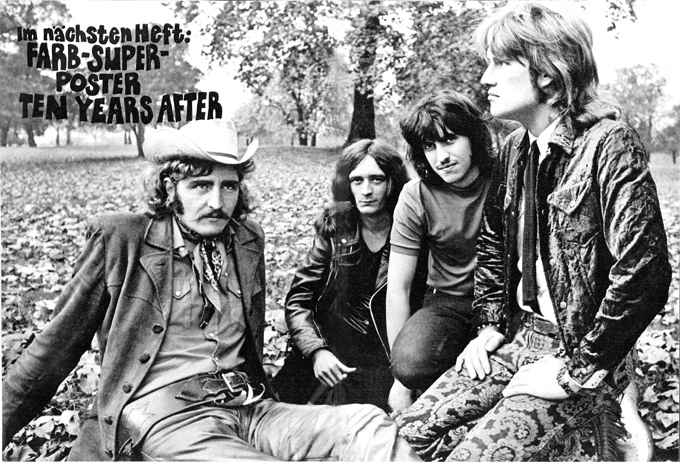
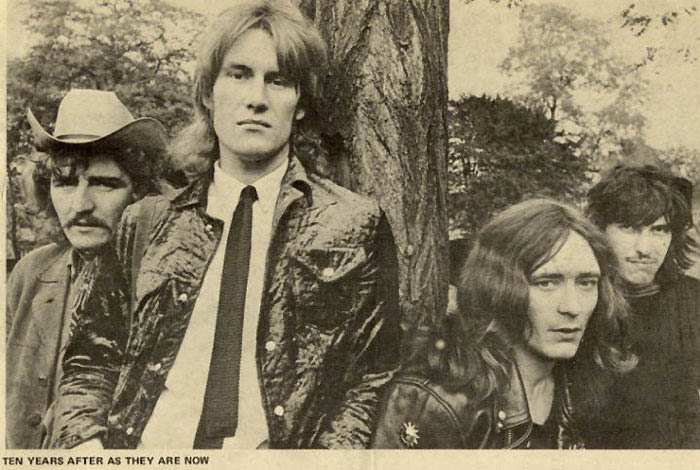
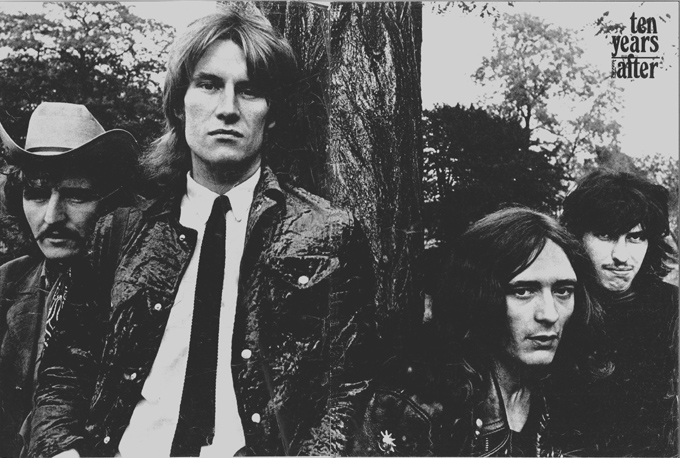
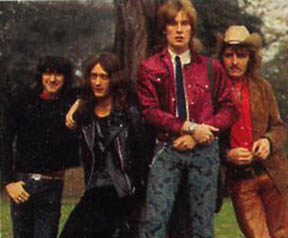

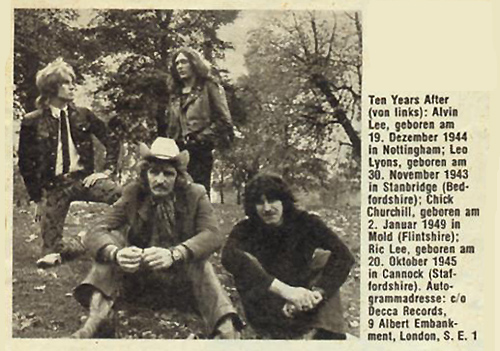
published in "Jackie" Magazine, No.
313, England, January 1970
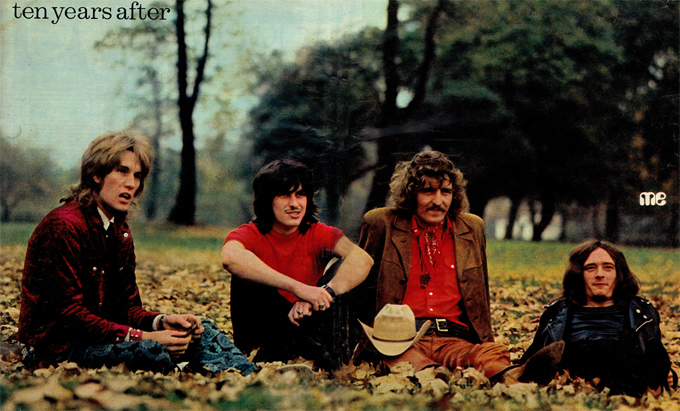
Musik Express Magazine 1969
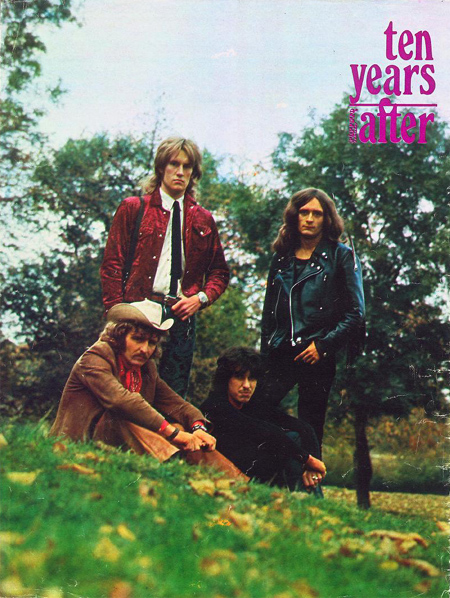
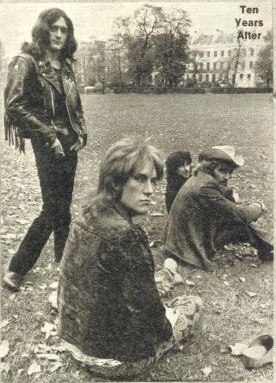
|

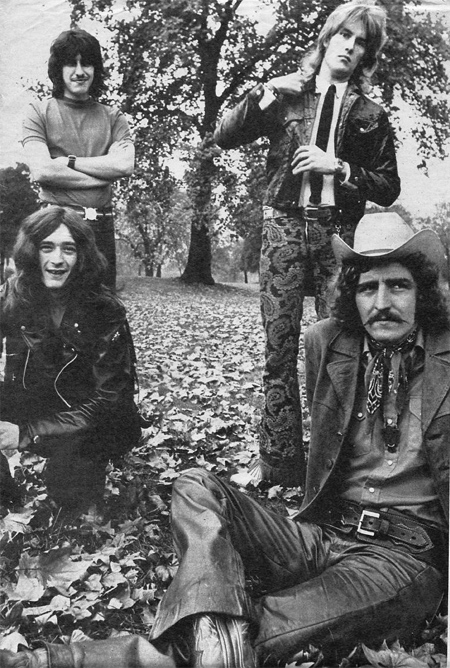
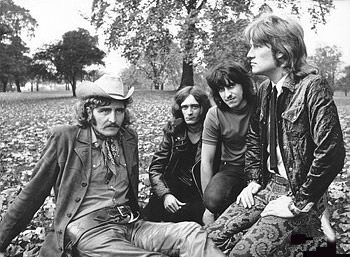
Ten Years After - 1969 Spring -
published in POP Magazine No. 10, Germany 1970

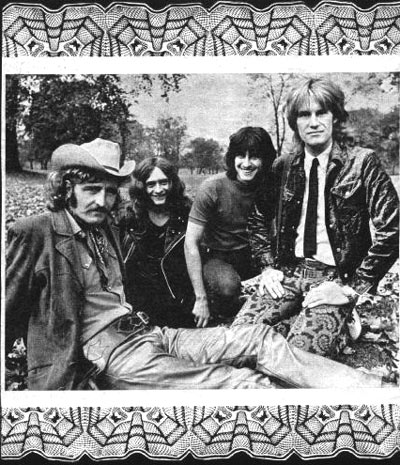
Spring of 1969 - TYA
published in popfoto Magazine in The Netherlands and Germany
|
January 1969 – Disc Time – What Makes A Group Pop
- With
Kennedy Brown.
Life can be short for the chart
seekers … but here are four who won’t disappear overnight.
New groups pop up at about six a
week, and most of them disappear in about four weeks after
the release of their first disc. But, I’ve just heard
records by four groups, three British and one American, of
whom I think we’re going to hear a lot more.
The first
British group with the unusual name of Ten Years After (how
can you fail with that?) – emerged as the stars of the 1967
Jazz and Blues Festival at Windsor, Berks, but had to go to
America before receiving recognition.
They came up with a
new album called Stonedhenge, which was originally recorded
for the American market. It should have equal success here.
Deram
|
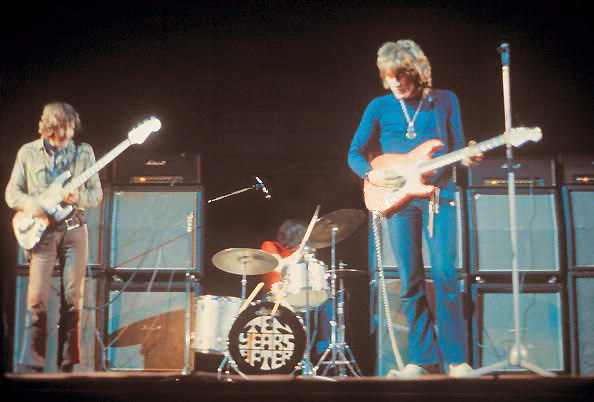
3, January 1969
- at the Van Dike Club in Plymouth, England
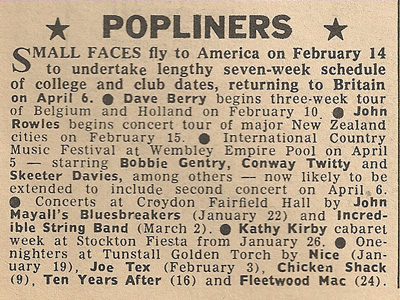
New Musical Express January 11, 1969
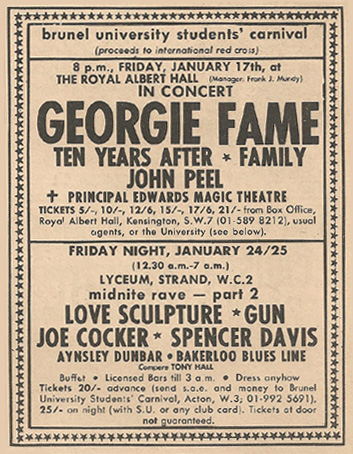
New Musical
Express January 11, 1969
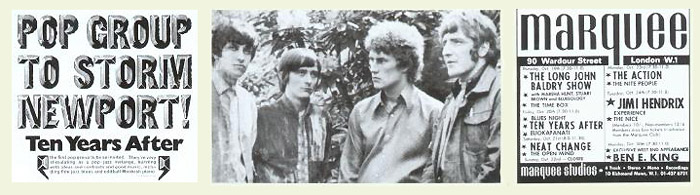
|
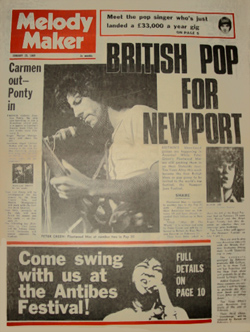
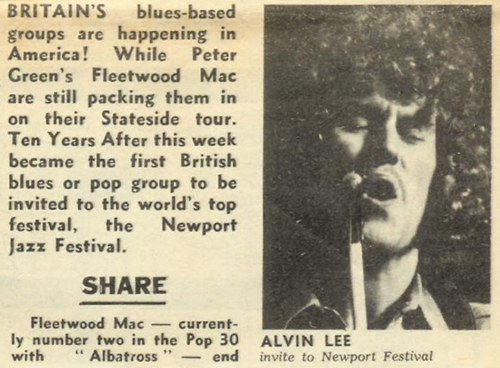
Melody Maker January 25, 1969
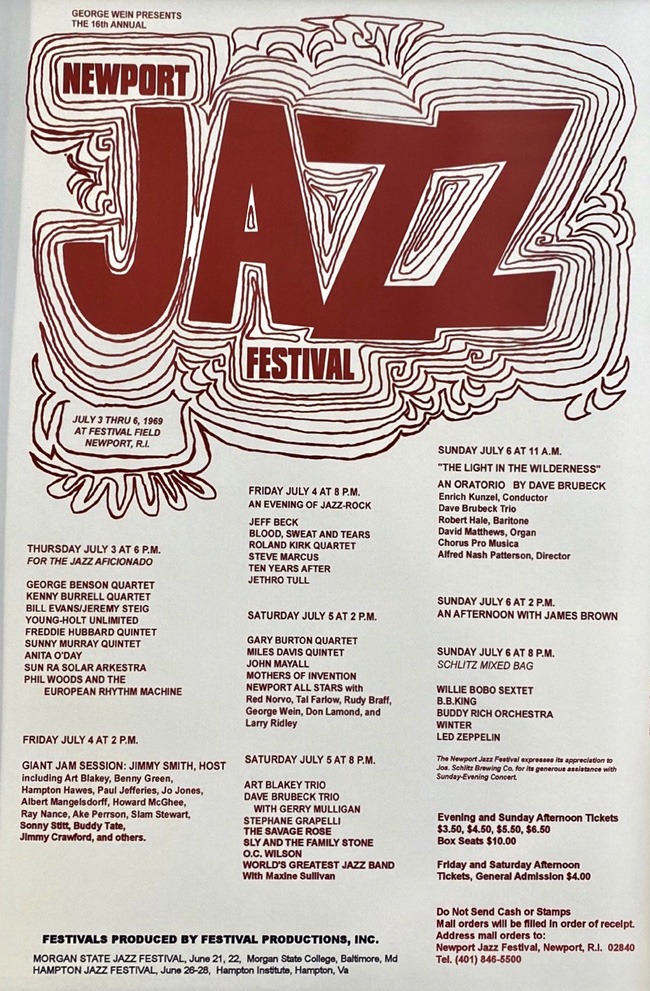
July 4 and 5 1969 - Newport Jazz Festival, Rhode Island
"Ten Years After
this week became the first British blues or pop group to
be invited to the world's top festival, the Newport Jazz
Festival".
They are also to play two American
concerts with the Woody Herman
Orchestra during their fourth Stateside trip in July.
The concerts arranged by Fillmore promoter
Bill Graham will be in New York and San Francisco and
the New York show will probably be at the famed
Carnegie Hall. Ten Years After's next American tour
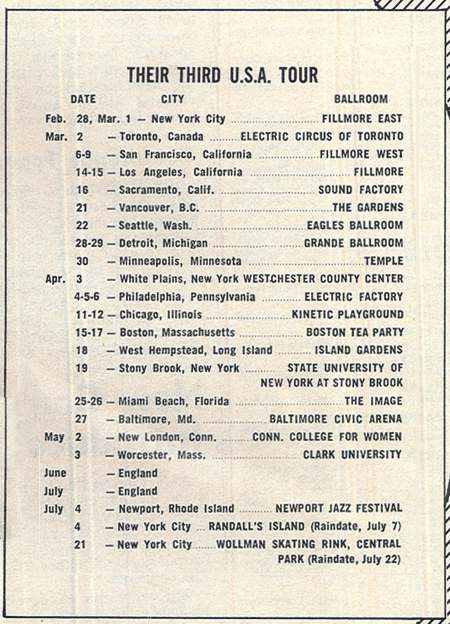
starts at the end of February. Their third album,
"Stonehenge" will be released by Deram
on February 7th. Ten Years After
perform - "I May Be Wrong But I Won't Be Wrong
Always" - "Good Morning Little School
Girl" and "Help Me". They appear on the
same night as Jeff Beck, Jethro Tull, Roland Kirk, Steve
Marcus and Blood Sweat and Tears. It is the only time
that rock bands are invited to play at this event. Alvin
Lee: "We started the tour at Newport, which didn't
really work out - to say the least. Shall we say
sometimes you get those days when you shouldn't have got
up, and that was one of them. We could not find the
dressing room, the amps broke down and the P.A. system
was crummy. We did three numbers and the guy who was
worried about the fences came on after the third number
and he said there would now be a fifteen minute
intermission, and we had only just warmed up.....can't
win them all !!" 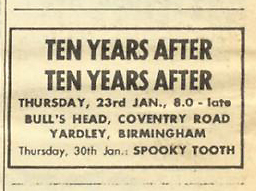
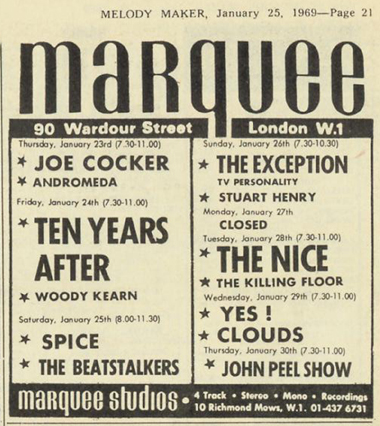
23rd Jan - January 24th (MM,
25 January 1969)
|
|
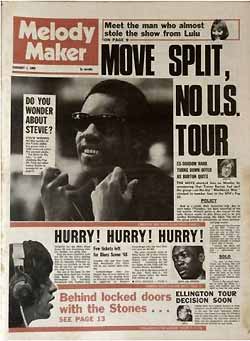
Melody Maker – February 1,
1969
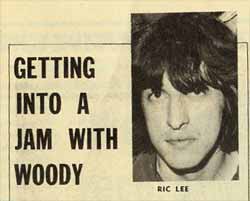
Getting Into A
Jam With Woody
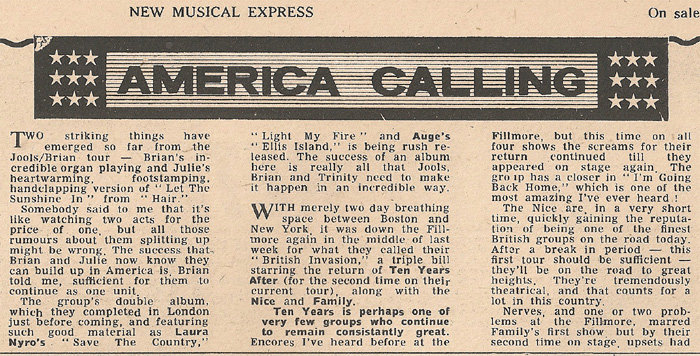
There will no doubt be cries of
“Sacrilege!” up thrown hands and heads shaken in despair
from some sections of the jazz fraternity at the news of Ten
Years After invitation to play at the renowned Newport Jazz
Festival in America this year. And they probably reacted in
the same way when Chuck Berry and Muddy Waters were invited
in previous years. But it proves that the Newport Jazz
Festival organizers are aware and open-minded enough to
accept that a certain area of the group scene is reflecting
a jazz influence more strongly than it has ever done and
that Ten Years After, who have made a huge impression in the
States, are a good example.
What could be an awe-inspiring occasion
for some groups, doesn’t appear so judging by the confidence
of drummer Ric Lee and bass guitarist Leo Lyons. “We’re not
really worried,” said Leo, when I met him and Ric last week.
“It’s a challenge if nothing else. When I heard about it , I
said “Oh really, how much are we getting?” he added with
mock nonchalance. “We weren’t surprised when we heard aboit
it. We knew there were whispers that it might happen and the
next thing we knew, we were reading about it on the front
page of Melody Maker,” said Ric. “It’ll give us a chance to
see all those jazz blokes”. Would the group be preparing
anything special for their Newport appearance in July? “No,
we’ll be doing the same sort of thing we’re doing already,”
replied Leo. “But we are rehearsing a new act before we go
to the States,” said Ric. ”It’ll be more interesting to see
what they say after we’ve done it,” reckoned Leo.
“I think one of the main reasons we’re
going is because of the gigs we’ve done in New York and the
help we’ve had from Billboard magazine.” Another
significant factor concerning Ten Years After’s moving into
the jazz field is that Woody Herman has agreed to play two
dates in concert with the group.
 They will be in New York
and San Francisco. The Herman band and Ten Years After will
each play a set and then both will get together for a jam
session. “Woody’s a progressive musician, even though he’s
been around a long time,” said Leo, “but he always has good
musicians. We’ll probably play “Woodchoppers Ball” and a few
standards.” Said Ric, “I just hope his blokes can play as
fast as we do. I’m only joking, I don’t think that will be
any problem.
We’ll just play our own versions and jam
away.” Ten Years After aren’t the first group to play a jazz
festival. Brian Auger, Julie Driscoll and the Trinity
appeared at the Berlin Jazz Festival last year, but Ten
Years After have made the big breakthrough with the Newport
invite and the Herman band dates. “Pop and jazz are getting
much closer together now,” opined Ric. “The jamming scene is
like the earlier jazz days”. “It’s becoming respectable,”
said Leo. “People like Leonard Bernstein talk about the
Cream and when people like him talk about it, it does mean
it’s being taken more seriously. “Newport will open up the
way for other groups. I quite enjoy it if you get yourself a
more ambitious task. It makes playing more interesting”. They will be in New York
and San Francisco. The Herman band and Ten Years After will
each play a set and then both will get together for a jam
session. “Woody’s a progressive musician, even though he’s
been around a long time,” said Leo, “but he always has good
musicians. We’ll probably play “Woodchoppers Ball” and a few
standards.” Said Ric, “I just hope his blokes can play as
fast as we do. I’m only joking, I don’t think that will be
any problem.
We’ll just play our own versions and jam
away.” Ten Years After aren’t the first group to play a jazz
festival. Brian Auger, Julie Driscoll and the Trinity
appeared at the Berlin Jazz Festival last year, but Ten
Years After have made the big breakthrough with the Newport
invite and the Herman band dates. “Pop and jazz are getting
much closer together now,” opined Ric. “The jamming scene is
like the earlier jazz days”. “It’s becoming respectable,”
said Leo. “People like Leonard Bernstein talk about the
Cream and when people like him talk about it, it does mean
it’s being taken more seriously. “Newport will open up the
way for other groups. I quite enjoy it if you get yourself a
more ambitious task. It makes playing more interesting”.
Article by Tony Wilson |
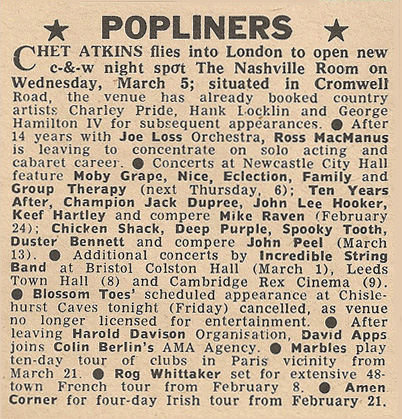
New Musical
Express February 1, 1969
|
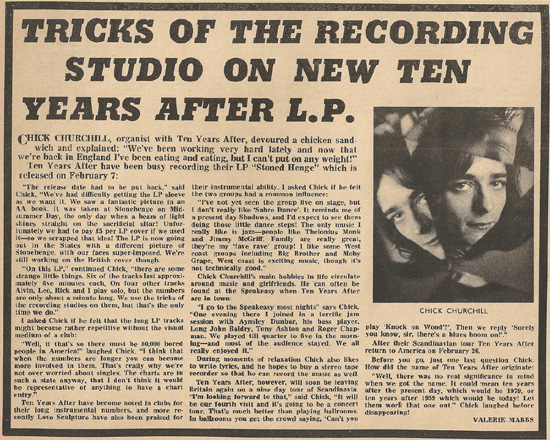
Record Mirror February
1, 1969
- click picture for the PDF file
Tricks of the Recording Studio on New Ten
Years After L.P.
Chick Churchill, organist with Ten Years After, devoured a
chicken sandwich and explained: “We’ve been working very
hard lately and now that we’re back in England I’ve been
eating and eating, but I can’t put on any weight ! Ten Years
After have been busy recording their L.P. “Stoned Henge,
which is released on February 7th.:
“The release date had to be put back,” said Chick, “We’ve
had difficulty getting the L.P. sleeve as we want it. We saw
a fantastic picture in an AA book. It was taken at
Stonehenge on mid-summer-day, the only day when a beam of
light shines straight on the sacrificial alter !
Unfortunately, we had to pay five pounds per L.P. cover if
we used it, so we scrapped that idea ! The L.P. is now going
out in the States with a different picture of Stonehenge,
with our faces super-imposed. We’re still working on the
British cover though.
“On this L.P.” continued Chick, “there
were some strange little things. Six of the tracks last
approximately five minutes each. On four other tracks,
Alvin, Leo, Ric and I play solo, but the numbers are only
about a minute long. We use the tricks of the recording
studio on them, but that’s the only time we do.
I asked Chick, if he felt that the long
L.P. tracks might become rather repetitive, without the
visual medium of a club. “Will, if that’s so, there must be
80,000 bored people in America !”
Laughed Chick. “I think that when the
numbers are longer you can become more involved in them.
That’s really why we’re more involved in them. That’s really
why we’re not over worried about singles, the charts are in
such a state anyway, that I don’t think it would be
representative of anything to have a chart entry”. Ten Years
After have become noted in clubs for their long instrumental
numbers, and more recently – Love Sculpture have also been
praised for their instrumental ability. I asked Chick if he
felt the two groups had a common influence: “I’ve not yet
seen the group live on stage, but I don’t really like “Sabre
Dance”.
It reminds me of a present day Shadows,
and I’d expect to see them doing those little dance steps!
The only music I really like is jazz-people, like Thelonius
Monk and Jimmy McGriff.
Family are really great, they’re my
“fave-rave” group! I like some West Coast groups, including
– Big Brother and Moby Grape, West Coast is exciting music,
though it’s not technically good”.
Chick Churchill’s main hobbies in life
circulate around music and girlfriends. He can often be
found at the Speakeasy when Ten Years After are in town: “I
go to the Speakeasy most nights” says Chick. “One evening
there, I joined in a terrific jam session with Aynsley
Dunbar, his bass player, Long John Baldry, Tony Ashton and
Roger Chapman. We played till quarter to five in the morning
– and most of the audience stayed. We all really enjoyed it!
During moments of relaxation, Chick also
likes to write lyrics, and he hopes to buy a stereo tape
recorder, so that he can record the music as well.
Ten Years After, however, will soon be
leaving Britain again on a nine day tour of Scandinavia.
“I’m looking forward to that,” said Chick, “It will be our
fourth visit and it’s going to be a concert tour. That’s
much better than playing ballrooms. In ballrooms, you get
the crowd saying, “Can’t you play Knock on Wood?” Then we
reply, “Surely you know, sir, there’s a blues boom on” !
After their Scandinavian Tour, Ten Years
After return to America on February 26th.
Before you go, just one last question
Chick. How did the name Ten Years After originate?
“Well, there was no real significance in
mind, when we got the name. It could mean, Ten Years After
the present day, which would be 1970, or Ten Years After
1959, which would be today! Let them work that one out”.
Chick laughed before disappearing!
By
Valerie Mabbs
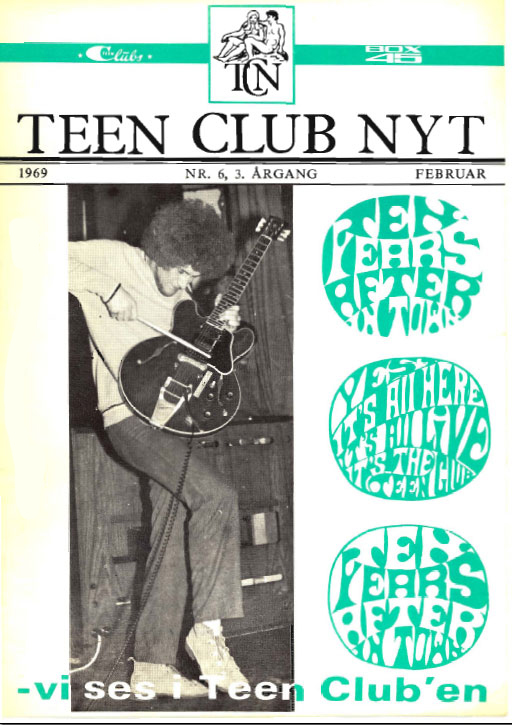
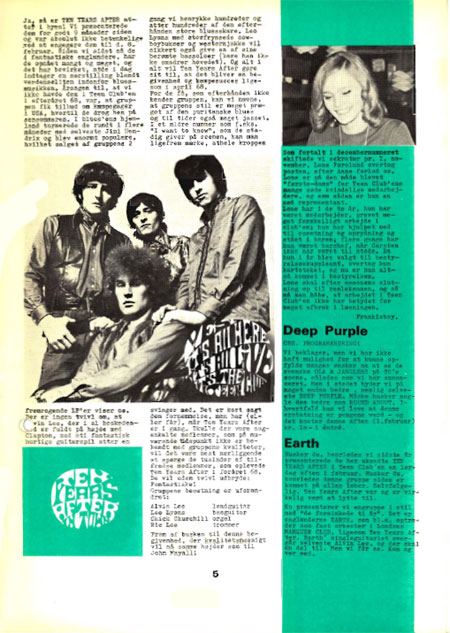
Gladsaxe Teen Club, Denmark
Ten Years After - Led Zeppelin - Deep Purple and Earth - all played
here
Earth - changed their name to "Black Sabbath" - a few weeks
after their gig
 |
|
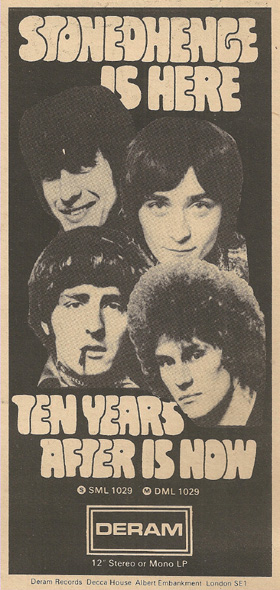
Record Mirror February
8, 1969 |
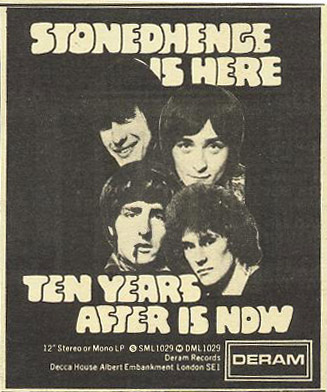
|
The
Album Charts At Number 6 in the UK
“Stonedhenge was the first experimental album, and also the
influence of the West Coast,
San
Francisco thing – strange sound effects and oddities going
on”.
Alvin Lee
|
|

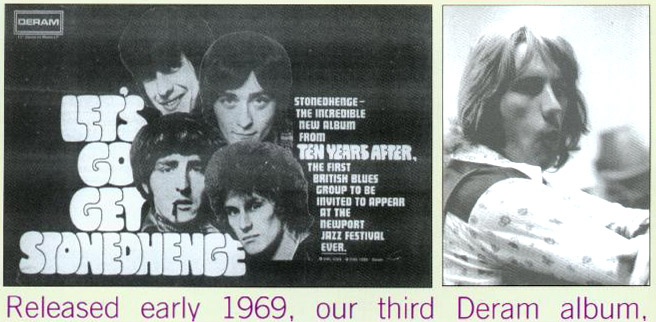
1969 - Ten Years
After Promo Poster by Deram Decca Records

Ten Years After
Poster
|
Ten
Years After – Stonedhenge – Review
Another “ADRM” London release, this is far
removed from the speedy boogie with which Ten Years After and
guitarist Alvin Lee are normally associated. That facet of the
band’s talents does surface on “Hear Me Calling” and
“Going To Try” but the rest of the album is much more
eclectic. Each musician is allowed a minute or so of solo
weirdness, with Ric Lee’s transformation of “Three Blind
Mice” into a drum solo, the strangest. And there are a couple
of cool blues songs which are remarkably restrained when
compared to the rest of the band’s output. The sound isn’t
as sharp as some London offerings, but certainly isn’t
anything to complain about either. |
Stonedhenge, is a really superb
record album. The group has moved on from blues and into an
area that’s impossible to stick labels on. It’s just
magnificent music. They get better and better. This is their
third album for Decca and to my mind, is the best yet.
There’s so much diversity of musical feeling, yet it’s all
part of what Ten Years After is about. They are more than
just a blues group, as they represent the current situation
in contemporary music. All the tracks are good. It’s all
good stuff and you can hear why they have been invited to
appear at the Newport Jazz Festival this year – February
1969.
Mike Capewess
|
|
Cash Box - 1969 –
Stonedhenge – Ten Years After – Deram – DES-18021
English blues group Ten Years After follows its chart-riding
“Undead” album with another strong collection of musical
pyrotechnics. The group’s third U.S. tour is kicking off in
late February, and should also help stir up sales. All the
tunes on this set, (except for one traditional blues tune)
are originals, most from the pen of lead guitarist Alvin
Lee, and many find the group dabbling in be-bop
improvisations. Should be in for heavy FM radio play |
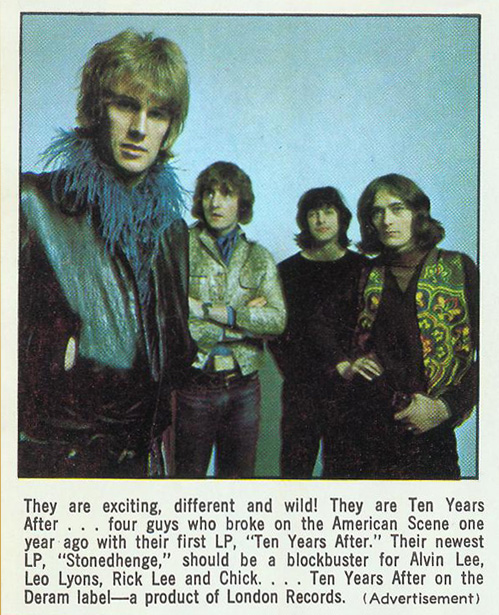

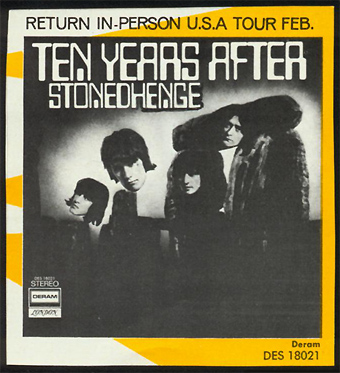
February 1969 - Stonedhenge Front Cover
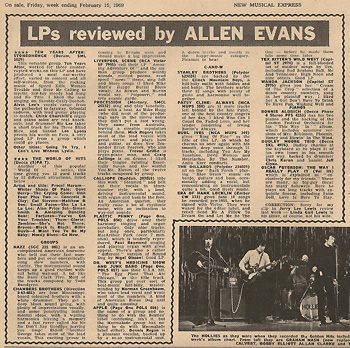
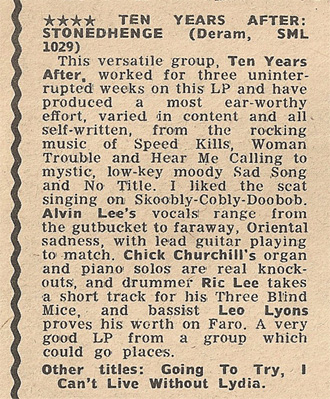
New Musical
Express February 15, 1969
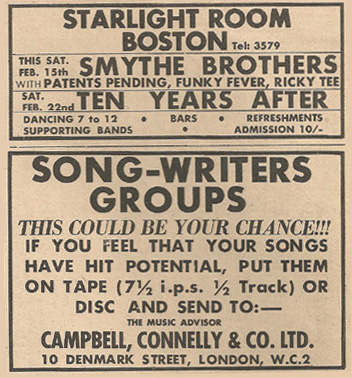
New Musical
Express February 15, 1969

Marquee Club, London - handbill and
programme

February 25 1969 - TEN YEARS
AFTER - Farewell Appearance prior to U.S. Tour
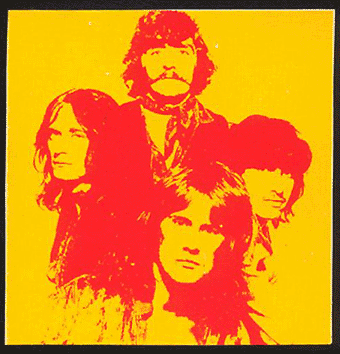
Was Stonedhenge “Filler” or was that “Experimental” ?
The reasoning behind „Stonedhenge“ was to show what Ten Years
After, as a hard working stage band could do in a controlled
studio setting. According to Alvin Lee, this album wasn’t
particularly what we wanted to do, but the way we did what we
happened to do…I still don’t know if this really worked, all I
do know is, it kept the wolf from the door and made us some
bread. This enabled us to pay the cost of hiring our own studio,
and being more free than ever before while recording.
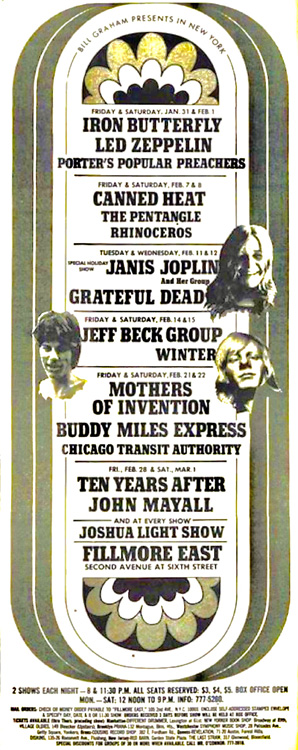
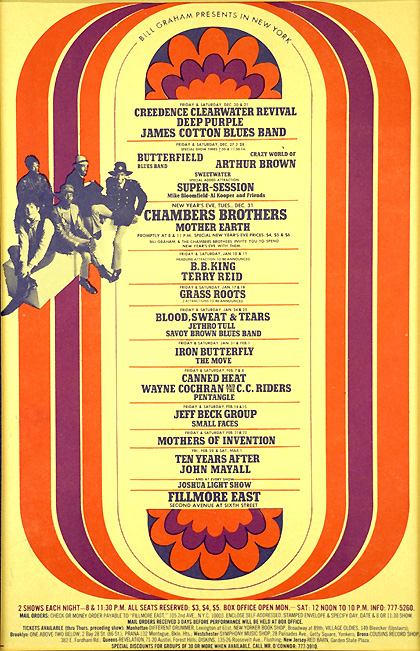
Fillmore East, New York City
- January 31 - March 1, 1969
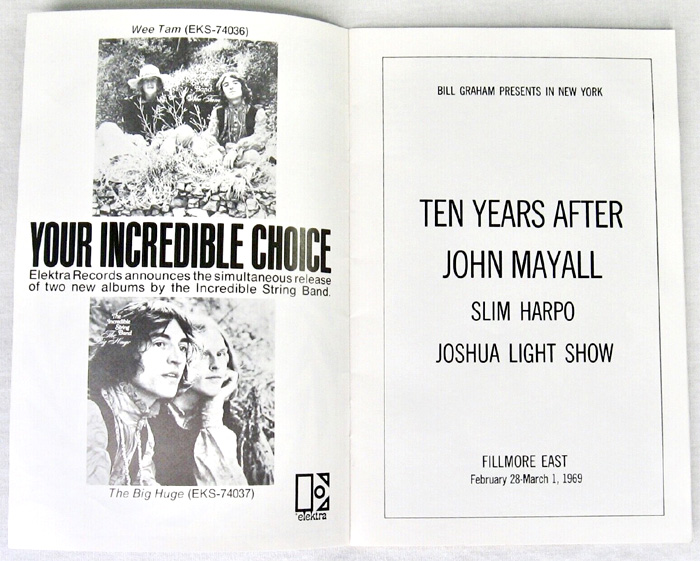
February 28 - March 1, 1969
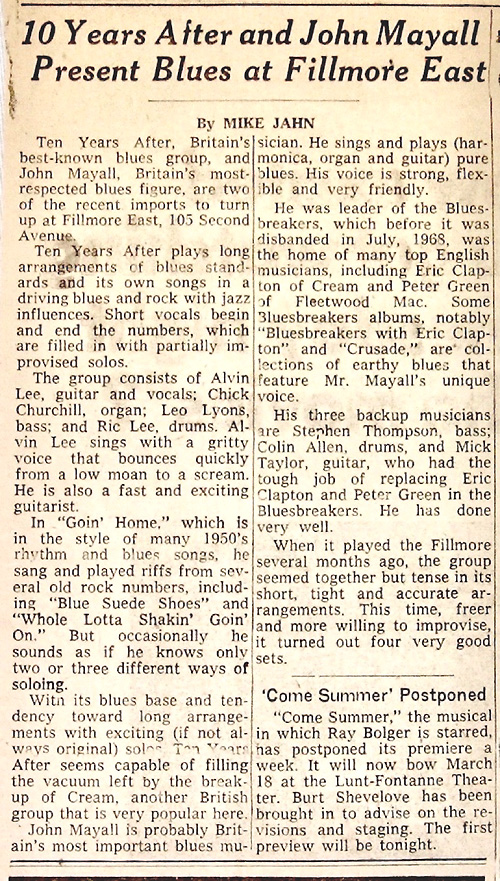
February 28 - March 1, 1969
- Fillmore East, NY Concert Review
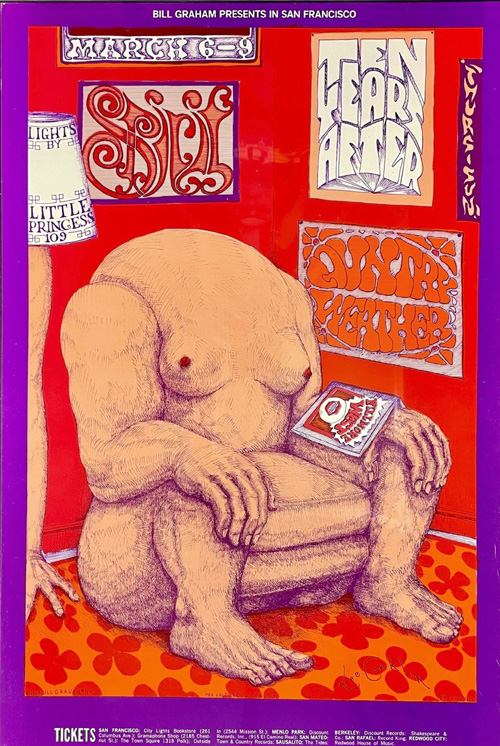
Fillmore
West, San Francisco, March 6 - 9, 1969 -
Artist: Lee Conklin
|
Colour Me Pop
Ten Years After –
Caravan – Family all made appearances on “Colour Me Pop",
March 1, 1969
but none of the
performances survive today. The BBC got a lot of viewer
complaints, so the powers that be enforced an “Underground
Embargo” which may have been the reason why the show was
cancelled soon there-after.
Ten Years After performed: A Sad
Song – No Title - I’m Going Home – bootleg audio exist.
It
was broadcast on Saturday March 1, 1969 – from
11:05 – 11:25
|
|
|
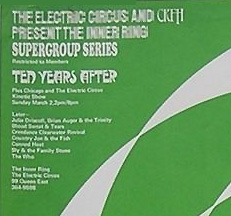
Ten Years After at the "Toronto Electric Circus"
Sunday, March 2, 1969 |
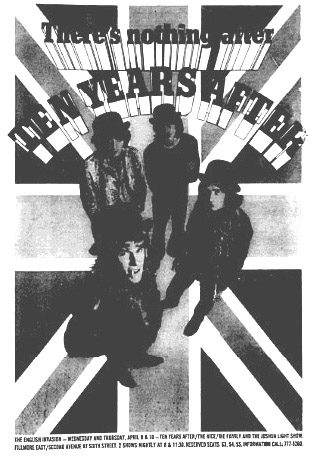
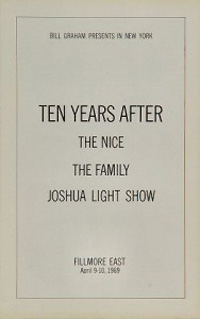
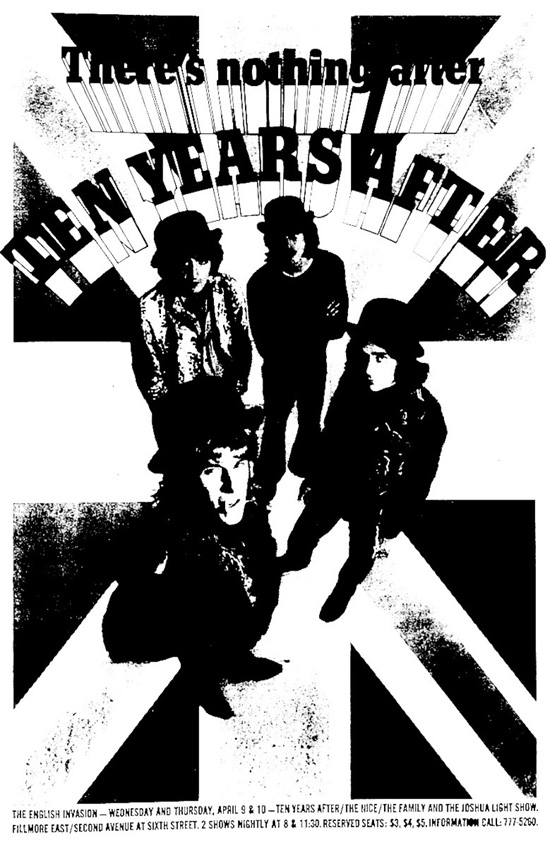
FILLMORE EAST - Wednesday and Thursday, 9 + 10 April
TEN YEARS AFTER, THE NICE, THE FAMILY and THE JOSHUA LIGHT SHOW 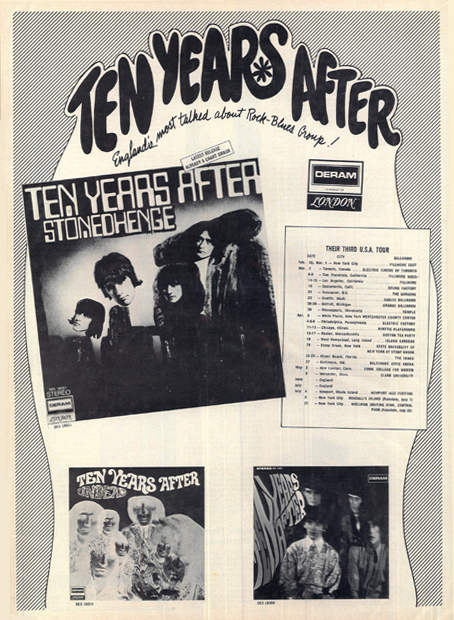
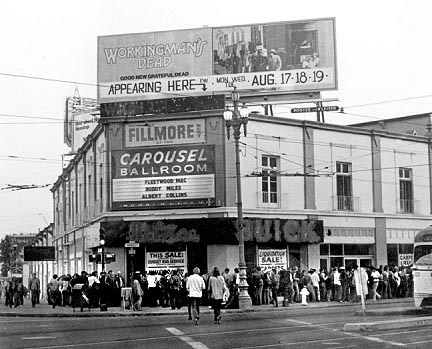
Fillmore West
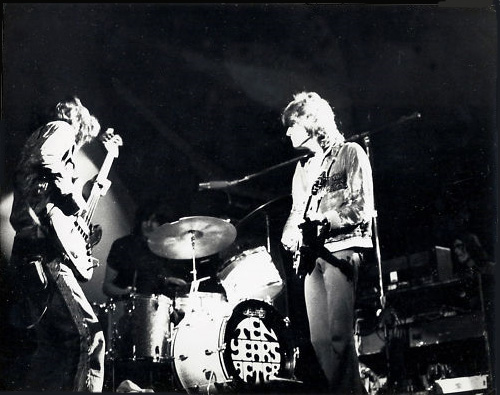
All four members on stage at
the Fillmore
East 1969
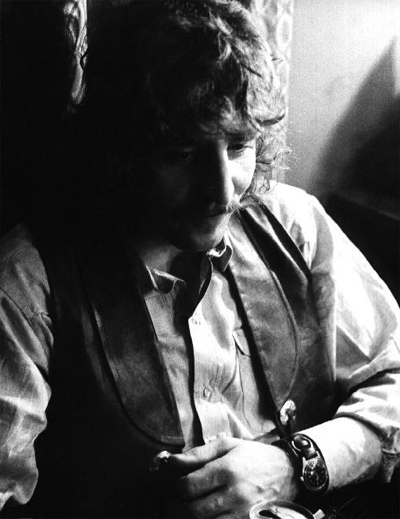
A great photo of Leo Lyons
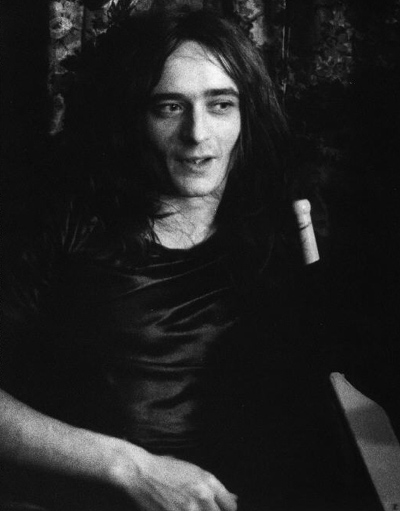
Backstage at the Fillmore East
1969 Chick Churchill
|
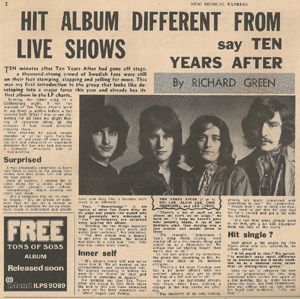
New
Musical Express March 8, 1969
click picture for the PDF file
|
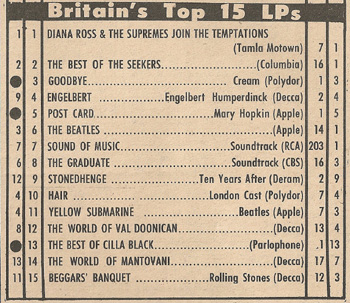
New
Musical Express March 8, 1969
|
|
Hit Album Different
From Live Shows – Say Ten Years After
By Richard Green –
For New Musical Express – March 8, 1969
Ten minutes after –
Ten Years After had gone off stage, a thousand – strong
crowd of Swedish fans were still on their feet stamping,
clapping and yelling for more. This was my first impression
to the group that looks like developing into a major force
this year and already has its first album in the L.P. chart.
Braving the bitter
cold of a Gothenburg night, I left the warmth of Ten Years
After’s hotel to see them in action before a full concert
hall. What I was to see dispersed for all time my slight
feeling of cynicism about all the eulogies I had heard
directed towards them. They over-ran by about twenty
minutes, or so, on each forty five minute set, and came off
stage wringing wet and exhausted – especially drummer Ric
Lee, who had delivered a fantastic twenty minute solo of
“Summertime”.
SURPRISED:
I was pleasantly
surprised to learn that is more to the group than seeing how
fast Alvin Lee can play his lead guitar. Back in London, I
invited Ric to come along for a drink and talk about the
group’s new album “Stonedhenge”, which entered the chart
last week.
“It’s a complete
trip on its own”. He began. “It’s an album of numbers that
we put on a record as opposed to numbers we do on stage.
Each track is individual and people have said they like it,
because each track is so different”. Thus, “Stonedhenge” in
not typical of what
Ten Years After do
on stage and people like myself, who had previously only
witnessed a “Live” performance are surprised when hearing
the album. “Keeping the two things separate helps you to
show your paces and widen your audience”. Ric explained.
“The first album was a display to get over to people, the
second was done in a rush and “Live”. This one, was taken
more slowly.
INNER SELF:
“It’s Alvin’s inner
self and we’ve come into it. We all worked on the
arrangements and contributed bits. We started recording it
before we went to the States in July and finished it
sometime in August”. Ric pointed out: That Ten Years After
are trying to lose their blues tag, and to this end have
rehearsed a new act for their American Tour, which began
last Friday.
“There’s a lot of
stuff on the album we can’t do on stage,” he went on. “I
hope we haven’t gone over people’s heads. A lot of our
numbers start, then develop into a jam-session and people
throw in ideas”. For example, “Sometimes I Can’t Keep From
Crying” once started off as a five minute thing, and ended
up as a twenty minute set. We always end up playing longer
than we’re due to do”.
In the two years of
its formation, the group has, according to Ric, become less
mild in its musical attitudes. “There’s a lot more freedom
now, but a lot more affinity with one another. Alvin’s only
got to drop the hint of a riff and we’re off”!
As one of the fast
rising groups, Ten Years After have noticed a change in the
way bands are playing. “The majority of up and coming
groups, are more concerned with something to say”. Ric
commented. “People didn’t use to think like that, they used
to put this bit and that with the formula. “It’s sad that
some groups used to do that, get a hit and disappear from
the face of the earth”.
HIT SINGLE:
How about a hit
single for Ten Years After, who are essentially an album
group!
“A hit would be nice,” Ric agreed. “It wouldn’t make much
difference to us-money-wise, but it would establish us as a
national name rather than an underground group”. Then, he
left to rehearse the new act, in preparation for two long
American Tours within the space of a few months. Ric is
quite pleased about the visits, but Pete Townshend, who was
sitting with us, just shook his head and muttered, OH MY
GOD”! |
Ten Years After –
Seattle, Washington – Live At Eagles Auditorium
March 22, 1969 –
Audience Recording
For those of you who
feel that the blues ended with Eric Clapton, you’ll be very
surprised at how good Alvin Lee is. He was simply blistering at
this 1969 Seattle Concert. Great Show!
The ferocity of Alvin
Lee’s guitar is incredible, he just pounds and shreds his way
through these cuts like a meat grinder making sausage. This is
when they were young and hungry and it shows. Loud, fast and
fun. The mix is pretty good, the guitar is placed out front, the
vocals are in the middle, drums and cymbals are slightly behind
the vocals and bass, somewhat in the back and not all that
muddy, considering. The sound quality is at least as good, if
not slightly better than the bands commercially released
“Undead” album of about the same time period, but the
performance is much more intense here.
Review By –
Peter Demarco Jr.

March 28, 1969 -
Rose Palace, Pasadena, California,
Alvin Lee with Gibson
Les Paul Gold Top
Photo by Mark Sullivan
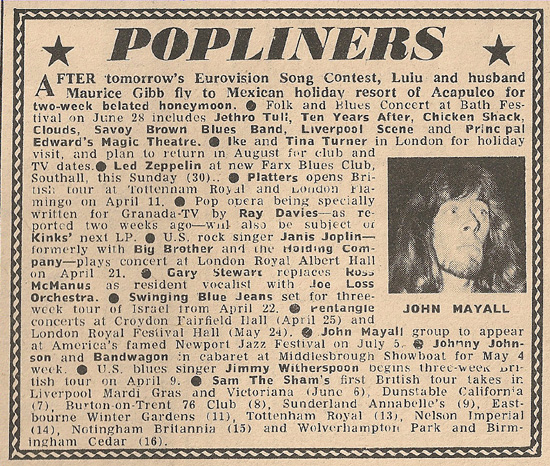
New Musical
Express March 29, 1969
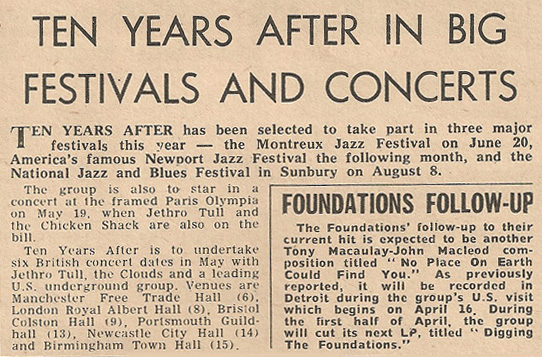
New Musical Express March
29, 1969
|
 |
 |
 |
|
New Musical Express - April
5, 1969
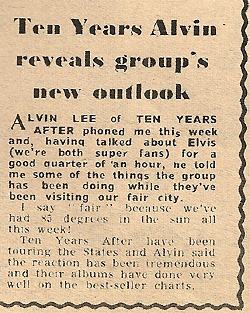
Ten Years
Alvin reveals group’s new outlook
Alvin Lee of Ten Years After phoned me
this week, and having talked about Elvis (we’re both super
fans) for a good quarter of an hour, he told me some of the
things the group has been doing while they’ve been visiting
our fair city. I say “fair” because we’ve had 45 degree in
the sun all this week! Ten Years After have been touring the
States, and Alvin said the reaction has been tremendous and
their albums have done very well in the best-seller charts.
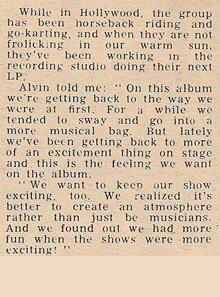
While in Hollywood, the group has been
horseback riding and go-karting, and when they are not
frolicking in our warm sun, they’ve been working in the
recording studio doing their next L.P. Alvin told me: “On
this album, we’re getting back to the way we were at first.
For awhile, we tended to sway and go into a more musical
bag. But lately, we’ve been getting back to more of an
excitement thing on stage, and this is the feeling we want
on the album. “We want to keep our show exciting too. We
realized it’s better to create an atmosphere rather than
just be musicians, and we found out we had more fun when the
shows were more exciting”!
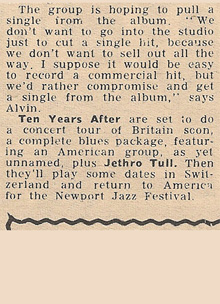
The group is hoping to pull a single from the
album. “We don’t want to go into the studio just to cut a
single hit, because we don’t want to sell out all the way. I
suppose it would be easy to record a commercial hit, but
we’d rather compromise and get a single from the album,”
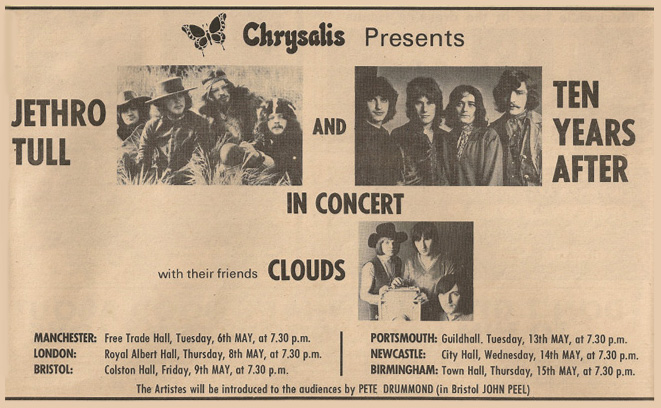
says Alvin. Ten Years After are set to do a concert tour of
Britain soon, a complete blues package, featuring an
American group, as yet unnamed, plus Jethro Tull. Then
they’ll play some dates in Switzerland and return to America
for the Newport Jazz Festival.
|
April 3, 1969 - "The Village Voice", New York
City

April 15 - 16 - 17 - The Boston Tea Party
Programme

1969 April 18 - Ten Years
After and Canned Heat at Hunter College, NYC, Advertisement
New Musical Express April
19, 1969
New Musical Express April 19, 1969
April 20, 1969 - The Rockpile, Toronto, Canada

|
Ten Years After – April
26, 1969 – Thee Image and The Miami Rock Scene:
Thee Image was
Miami’s biggest and best known psychedelic rock club venue,
although it was only in operation for thirteen months. It
was located in a former thirty two lane bowling alley at
18330 Collins Avenue, just north of Miami in sunny Isles
Beach. The venue was principally owned and operated by two
brothers, who also owned a pharmacy store and made sun tan
lotion. Also involved with a band from Tampa Florida that
was originally called The Motions, who
changed their name to The Blues Image, in homage to The
Blues Project.
Blues Image were
reputedly hip Florida’s best live band, that had twin
drummers and a funky, swinging sound. Besides helping
operate the club, they were also the house band and
apparently they played there just about every weekend,
whether they appeared on the concert bill or not. Thee Image
opened on March 15, 1968 featuring The Mother’s Of
Invention.
The last band to
play there was Ten Years After, and then the venue closed
soon after that and was demolished. It’s my understanding
that the owners were under great pressure to shut down. This
after the Jim Morrison incident at the Dinner Key Club, that
was also in Dade County Florida.
Ten Years After – At
Thee Image:
There’s nothing
cerebral about this group, just high energy British Blues
Rock. Alvin Lee was one of the fastest players that I heard
on the scene at the time. His singing style reflected an
Elvis influence. The bass player (Leo Lyons) had a
hard-driving-slapping style that helped propel the band.
Thee Image Club
consisted of a big open ballroom floor, with three stages,
a meditation room, multiple seperate rooms, day-glow paint
everywhere, black-lights and along the wall were Ampeg
Speakers, so it wasn’t just a converted building. The club
seems to be remembered fondly by performers and fans alike.
There’s very little in the way of photographs, live
recordings or tapes, all that remains is the occasional
poster that comes around from time to time. Visiting bands
were very impressed with The Blues Image.
Frank Zappa himself
suggested that if they wanted to make it big, they would
have to break into New York City or Los Angels, and in the
spring of 1969 they closed Thee Image and moved to Los
Angels California. The briefly worked backing Eric Burdon
and from there the band scored a big success with their big
hit single “Ride Captain Ride” in 1970, which reached number
four on the Billboard Hot 100 Chart…..and “Pay My Dues”.
Who Performed At
Thee Image:
Ten Years After –
Frank Zappa and the Mothers of Invention – Led Zeppelin –
The Grateful Dead – The Loving Spoonful - John Sebastian –
The Velvet Underground with Nico Country Joe and the Fish –
Big Brother and the Holding Company – Cream – The Yardbirds
– The Troggs – Procol Harum – The Electric Flag – Paul
Butterfield Blues Band – The James Cotton Blues Band (James
jammed with The Blues Image until the sun came up) – Cactus
Elvin Bishop Blues Band – Savoy Brown Blues Band – and the
U.S. Premier of Magical Mystery Tour…Fantasy – Canned Heat –
Tiny Tim – The Jeff Beck Group with Rod Stewart –
Steppenwolf – Blues Image – The Doors – Nicky Hopkins – Blue
Cheer – Spirit - (Randy California)
Deep Purple – Jethro Tull – John Mayall’s Bluesbreakers with Mick Taylor – Jimi
Hendrix. Jefferson Airplane - Ted Nugent and the Amboy Dukes
- Blood Sweat and
Tears.
The Jimi Hendrix
Story – Playing Thee Image For Free:
Jimi Hendrix was
scheduled to play at Gulf Stream Race Track, but the concert
was rained out. The promoters couldn’t refund the money at
this point, so we invited Hendrix to Thee Image, where we
would throw open the doors to anybody who wanted to walk in.
Jimi went on the Gulfstream stage and invited everybody to
come to the club. It was 8:00 on a
stormy tropical night, we called all our concession people,
the ice cream vendors, the chocolate cake sellers, the hot
dog guys, the body painters and ask them to come right down.
The body painters gave away Day-Glow-Paint that lit up under
the black-lights, which was a big deal in concert lighting
at the time, and Thee Image boasted one hundred black-light
bulbs. Jimi, his roadies
and his band showed up as promised, for free and started to
set up on the stage. The club already had a wall of Ampeg
speakers with enough amps to blow the windows out. There
were also the two giant strobe lights with a slow to fast
dialler that made people look like they were moving very
fast, or in very slow motion, like a haywire silent film. Word was getting
around, kids were calling kids and by 9:00 the parking lot
was packed full, and so was Collins Avenue, and there was a
traffic jam right down to Haulover Beach.
Jimi started playing
at about 9:00. He began by using all of the Thee Image’s
speakers and his own to produce wild feedback wailing, and
that got people’s attention. Then he jammed with the house
band, The Blues Image, in a set that never stopped until
after midnight. The audience, full of painted bodies, mostly
sat on the floor and listened. They were all in various
states of high, higher and highest, while Jimi played rock
guitar that was more dramatic than anything, most of the
audience had ever heard. His guitar solos melted down and
re-formed, turned into vivid images and then into smoke. It
was a wild night of cheering. Then the ice cream battle
began. Somebody brought Jimi an ice cream cone with a ball
of chocolate on it. Jimi threw the ice cream ball to
somebody in the crowd. That somebody threw it back at Jimi. “get me ten cones”
Hendrix called out. He passed them to everyone in the band,
and they began to throw ice cream balls at each other.
Pretty soon, hundreds of members of the audience raced to
the concession stand to buy scoops of ice cream, forget the
cone. In fifteen minutes
the air in the club, under the day-glow lights, was filled
with flying ice cream balls. They hit the walls, the
speakers, people’s heads, hair and clothes. Then, when the
ice cream ran out, they all began throwing chocolate cake.
Meanwhile, Jimi and the band kept right on jamming away.
Then Jimi says, “let’s go swimming”. He left the stage
without his guitar, walked right out the front door, like a
Pied-Piper, as he walked past the IHOP (International House
of Pancakes) then up to Collins Avenue, with three to four
thousand kids dancing insanely behind him. This was a few
months before Jimi played his Star-Spangled-Banner at the
Woodstock Festival – in August of 1969.
About the Blues
Image. They were a well respected band among their peers. It
was reported in Melody Maker, that Jimi Hendrix said, “The
Blues Image was one of the best up and coming bands around”.
Shortly before Jimi’s death, he was seen jamming on stage
with Manny Bertematt at the popular underground club, “The
Experience” on the Sunset Strip in Los Angeles. The
Blues Image debut album was released in February 1969. Their
second album was released April 1970 and featured their hit
song “Ride Capitan Ride” with Kent Henry (Lord Sutch) on
guitar and Pinera on lead guitar at the end of the song. The
song was co-composed by Pinera and Konte. It sold over one
million and earned the band a gold record.
Bertematti went on
to work with The New Cactus Band (Senseless Rebel and Hook,
Line and Sinker). Pinera went on to become part of Iron
Butterfly (Butterfly Bleu and Easy Rider), Ramatam with
Mitch Mitchell and guitarist extraordinaire April Lawton.
Alice Cooper (I’m
Eighteen and Schools Out). Konte joined Three Dog Night.
Lala played with
Stephen Stills / Chris Hillman and their group Manassas.
Kent Henry also played lead guitar with Steppenwolf just
prior to their break-up. |
|
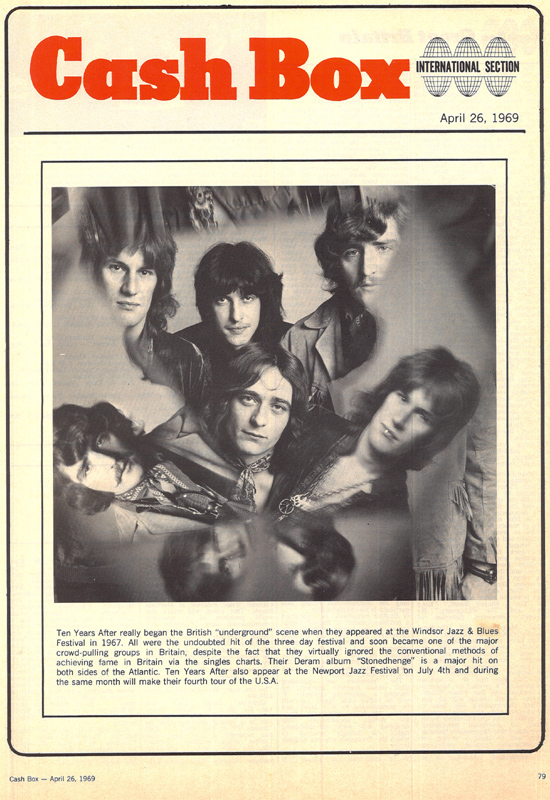
Cash Box Caption
April 26, 1969
Ten Years After,
really began the British „Underground“ scene, when they
appeared at the „Windsor Jazz & Blues Festival in 1967. All
were the undoubted hit of the three day festival, and soon
became one of the major crowd – pulling groups in Britain,
despite the fact that they virtually ignored the
conventional method’s of achieving fame in Britain, via the
singles charts. Their Deram album “Stonedhenge” (released
February 22, 1969) is a major hit on both sides of the
Atlantic. Ten Years After also appear at the “Newport Jazz
Festival” on July 4, 1969 and during the same
month will make their fourth tour of the U.S.A.
|
|
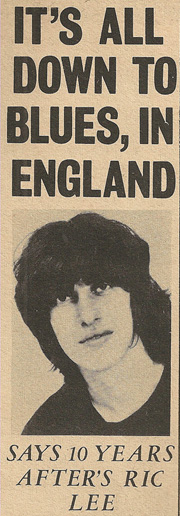 |
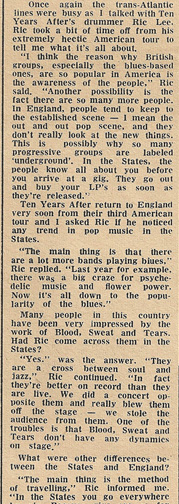 
Record
Mirror May 3, 1969
|
|
click picture
for PDF file |
click picture
for PDF file |
|
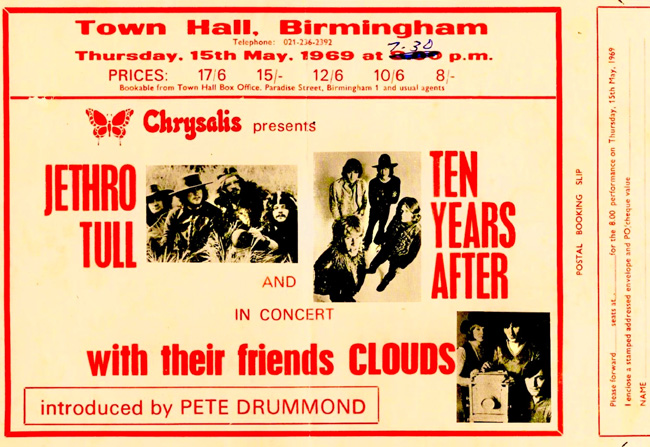
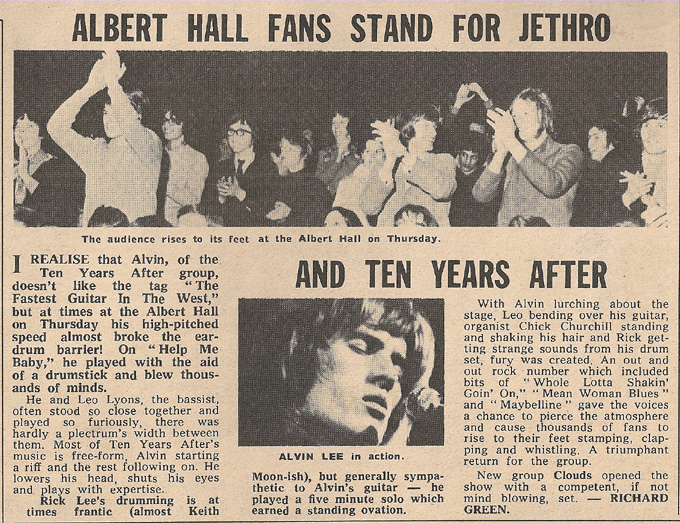
New Musical
Express May 17, 1969
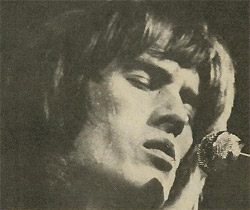
Photo by Thom Lukas |

| New
Musical Express,
May 24, 1969
Three
Months Before Woodstock 1969
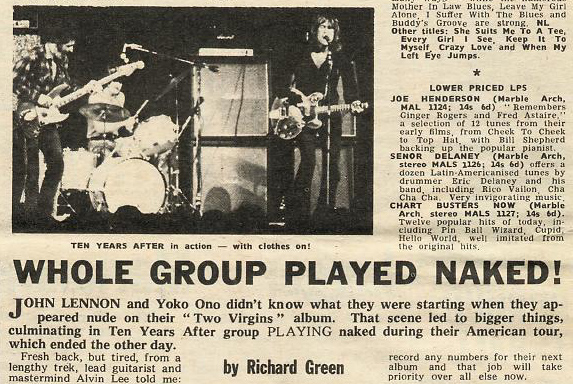
John
Lennon and Yoko Ono didn’t know what they were starting when
they appeared nude on their “Two Virgins” album. That scene
led to bigger things, culminating in Ten Years After Group
Playing Naked, during their American tour, which ended the other
day.
Fresh back, but tired, from a lengthy trek, lead guitarist
and mastermind Alvin Lee told me, ”We played in the nude at
a free concert in Chicago. It was a free expression concert, one
of those hippy places. Nudity is really very popular over there
– it’s a minor revolution against society.
“When
you first get over the hang-up of playing without clothes it’s
quite fun. Freedom of expression is a nice thing, I don’t
think it’s something we could try here, though. At least
it’s a better way of revolting than beating up little old
ladies or smashing windows”.
Ten
Years After found the Americans are still very pro the English
musical scene. “The scene is going very much towards the
English thing at the moment,” he pointed out. “They take a
lot of interest in our charts and what’s going on here.
“That nudity bit…it might be an emphasis of what John Lennon
and Yoko Ono are doing. People there think they go everywhere
without their clothes on.
Reaction
to Ten Years After in America was enthusiastic and Alvin gave me
one example of the type of response they were getting. “We
came off the other night, had a shower and a wash and they were
still clapping”. He recalled. “So we had to go on again”.
Alvin feels that the group worked possibly a bit too hard.
They certainly had no time to record any numbers for their next
album and that job will take priority over all else now. “Some
of the English bands are happening in America,” he revealed.
“Jeff Beck is big, only nobody knows if he wants to play or
not, he keeps going over and coming back. The “Nice” “The
Family” and “Led Zeppelin”
are very big”.
Alvin
is moving into a new Baker Street home, having been unkindly
asked to leave his last residence. He told me the circumstances
surrounding the move. “I got kicked out of the last one
because the landlord said I looked like the kind of person who
could smoke drugs! It was a private estate and all the
neighbours were snobbish. They looked at this fellow with long
hair and didn’t like the look of him, so I had to go”.
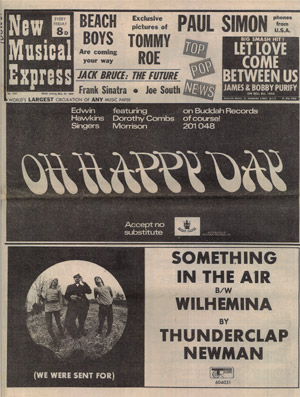
|

Ssssh Album - Recorded June 1969
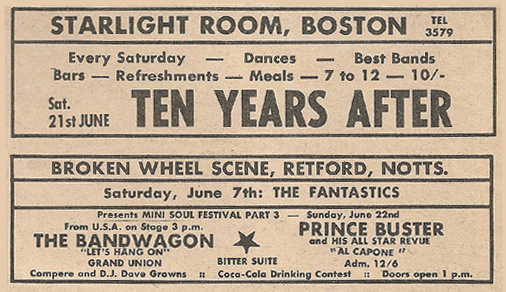
New Musical Express
June 7, 1969
|
The Boston Tea Party:
Was a venue, small music
hall, housed in a building that was formally a Jewish Synagogue,
number 53 Berkeley Street, and opened on January 20, 1967 It was
located in Boston, Massachusetts, and every week groups like Ten
Years After, The Grateful Dead, Led Zeppelin, The Who, The Jeff
Beck Group (with Rod Stewart and Ronnie Wood), Joe Cocker, The MC5
(with Fred “Sonic” Smith), The Velvet Underground (with Nico),
Little Richard Black Diamond, The James Cotton Blues Band, Johnny
Winter, Sons of Champlin, Ten Wheel Drive, Fleetwood Mac, The Byrds,
The Raven, and the home of Aerosmith from 1970 to 1972 would
perform there. It was a great magic time for music in Boston and
that time in the late 1960’s and into the early 1970’s. The Boston
Tea Party was Boston’s premiere rock `n´ roll and psychedelic club,
and it helped break uncounted British and American bands stateside,
before its unfortunate closing in the early 1970’s. John Cale
played his last show with the Velvet Underground in the late
1960’s. He was later replaced by a native Boston guitarist, Doug
Yule. In 1969 the venue moved its location next to Fenway Park
where today it remains as The Avalon.
Part Two Boston Tea Party:
Muddy Waters, Howlin` Wolf,
John Lee Hooker. Van Morrison played there when he first moved to
Cambridge from Belfast and was in the process of developing
material for his classic album “Astral Weeks”. Big Boy Crudup
played there in 1969, it was also the first place that Brian Auger
played in America. The Mothers of Invention (Frank Zappa) and Cream
played there. Many musicians and bands played here as a warm up
place in order to perfect their performances before heading into
New York City for the big time. Jonathan Richman started here long
before he became Jonathan Richman and The Modern Lovers. Peter Wolf
was with the band The Hallucinations before joining The J. Geils
Band and B.B.King played there. Don Law and Steve Nelson managed
the Boston Tea Party.
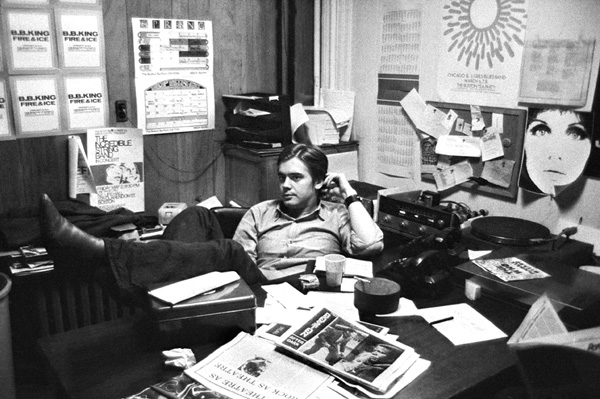
Don Law - Boston
From Circus Magazine - Jimmy Page is quoted as
saying: “ I can tell you when I knew we’d broken through, which was
at San Francisco. There were other gigs, like The Boston Tea Party
and the Kinetic Circus in Chicago which have unfortunately
disappeared as venues, where the response was so incredible, we
knew we’d made our impression….but after the San Francisco gig it
was just….bang!”
John Paul Jones recalls the
show:
As far as I’m concerned,
the key Led Zeppelin gig, the one that put everything into focus
was the one that we played on our first American Tour at The Boston
Tea Party. We had played our usual one hour set, using all the
material from our first album and Page’s “White Summer” guitar
piece, and by the end, the audience just wouldn’t let us off the
stage.
It was in such a state that we had to start throwing ideas
around….just thinking of songs that we all might know or some of us
knew a part of and work it from there. So we’d go back and play
things like “I Saw Her Standing There” and “Please Please Me”… the
old Beatles favourites. I mean, just anything that would come into
our heads and the response was quite amazing. There were kids
actually banging their heads against the stage….I’ve never seen
that at a gig before or since, and when we finally left the stage
we’d played for four and a half hours. Our manager Peter Grant was
absolutely ecstatic. He was crying and hugging us all. You
know….with this huge grizzly bear hug. I suppose it was then that
we realized just what Led Zeppelin was going to become. |
|
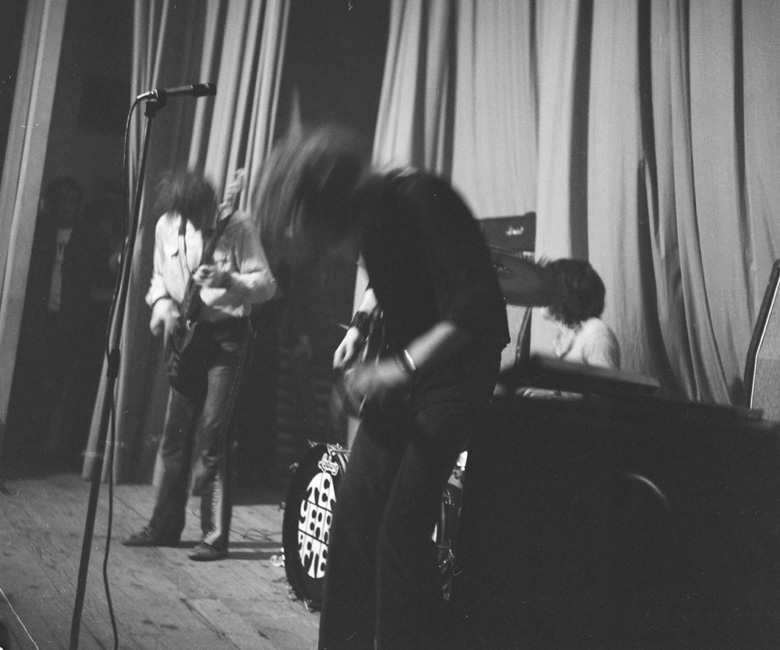
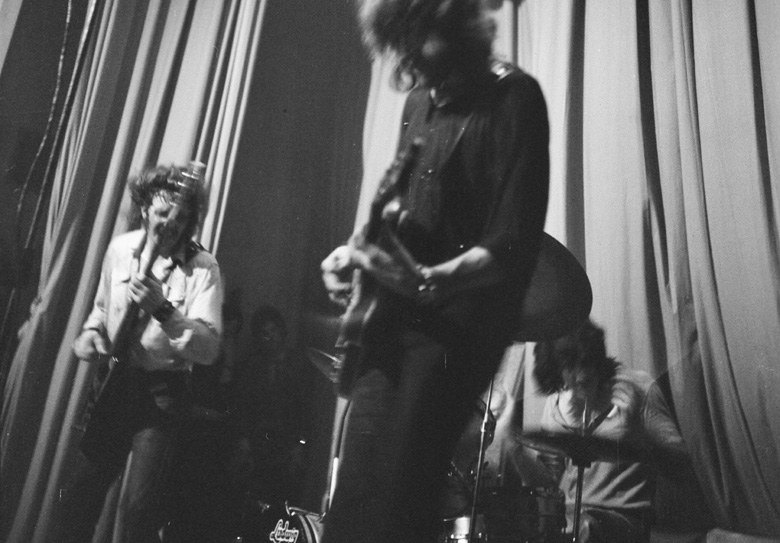
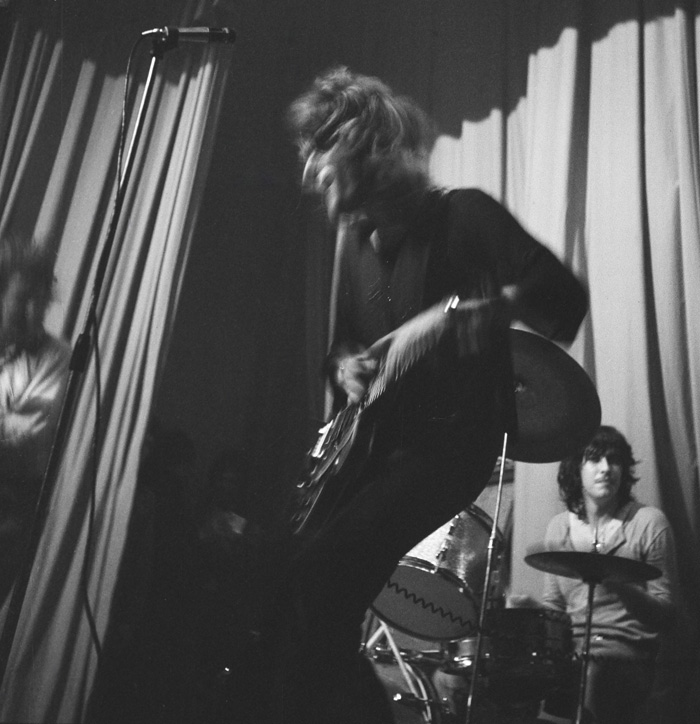
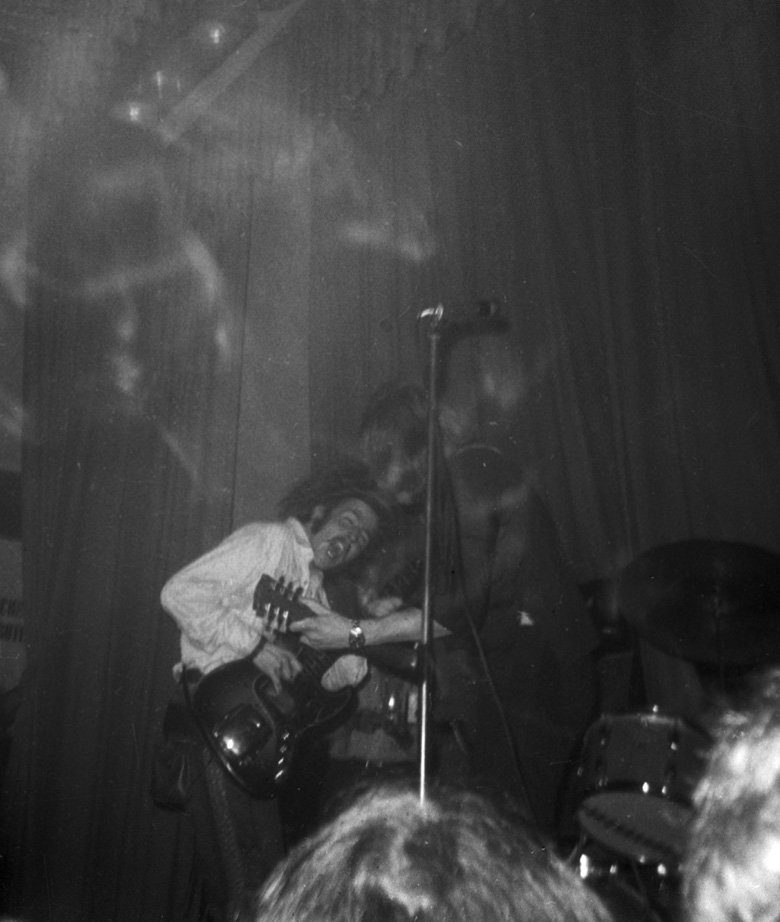
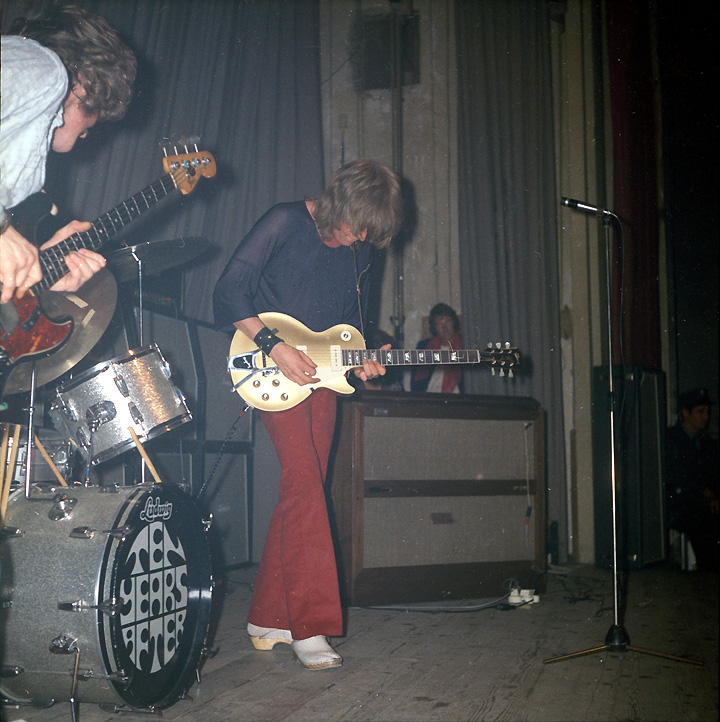
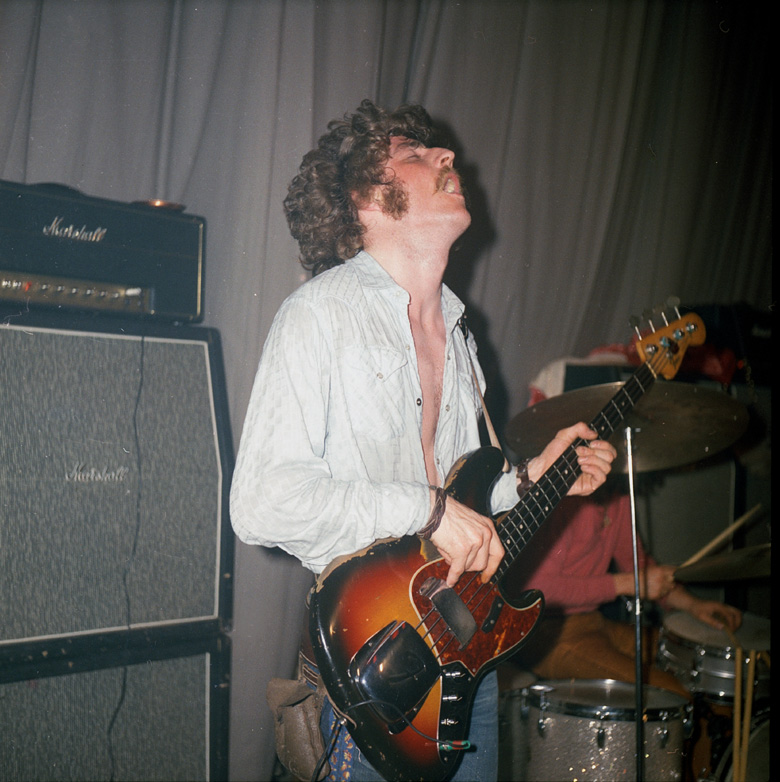
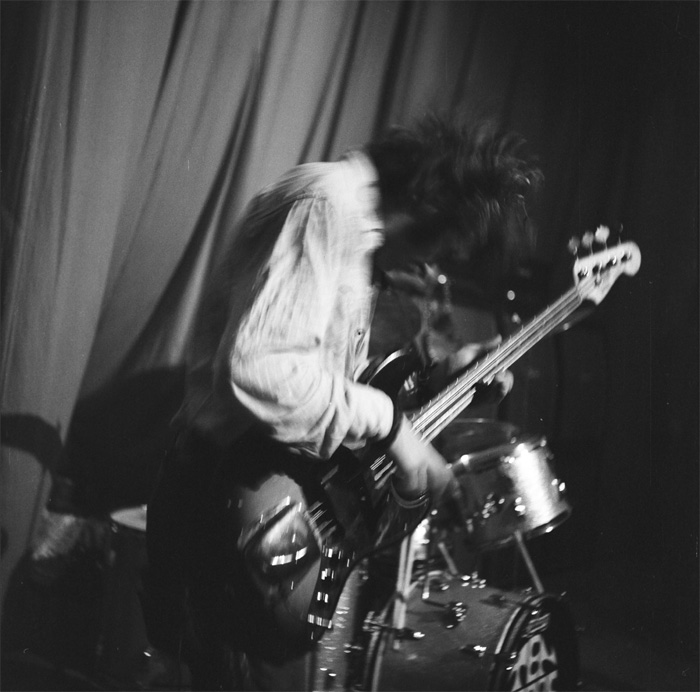
1969, June 19 - Albisriederhaus, Zürich, Switzerland


1969 June 19,
Albisriederhaus, Zürich, Switzerland
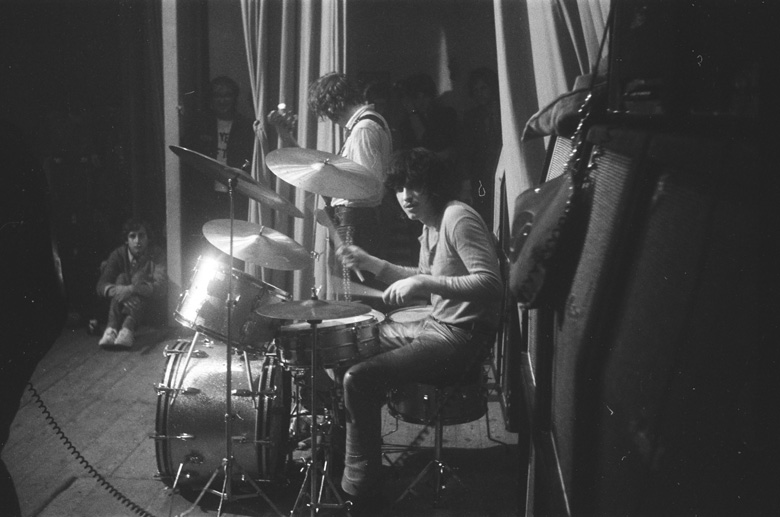
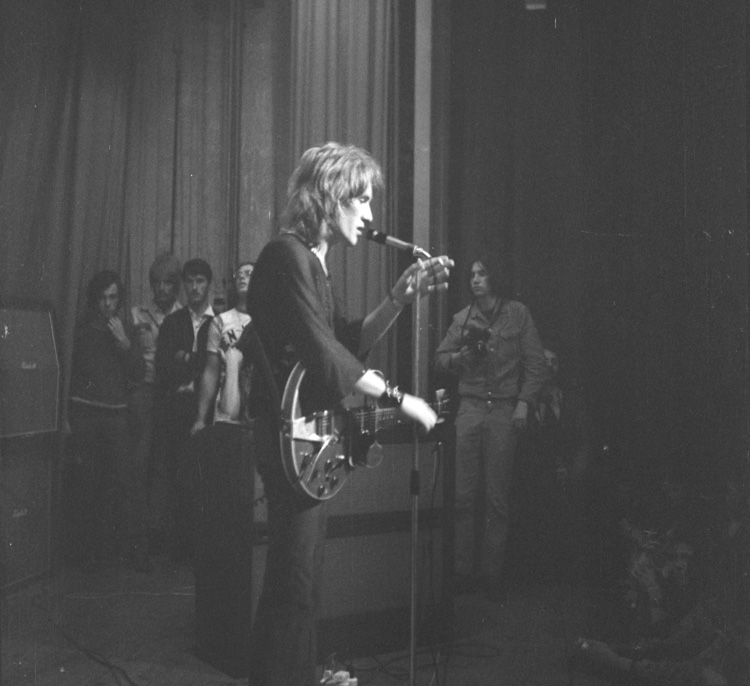
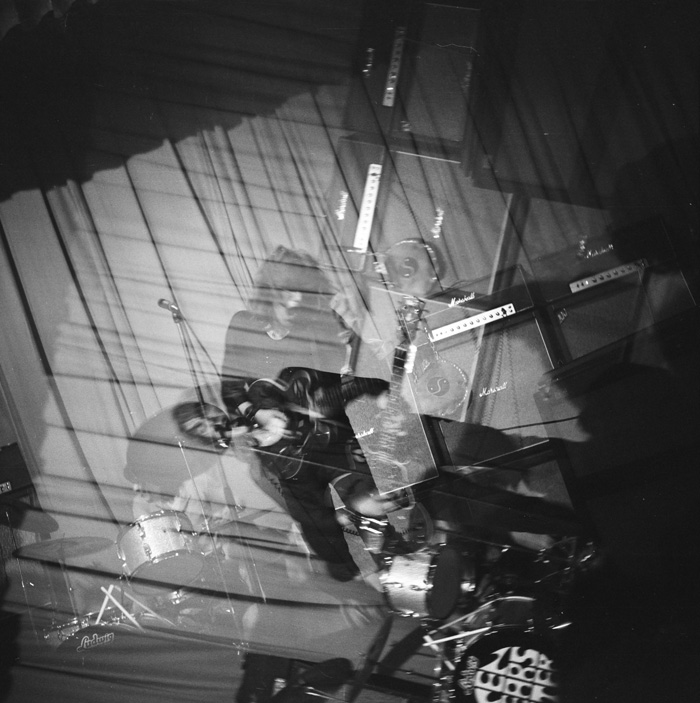
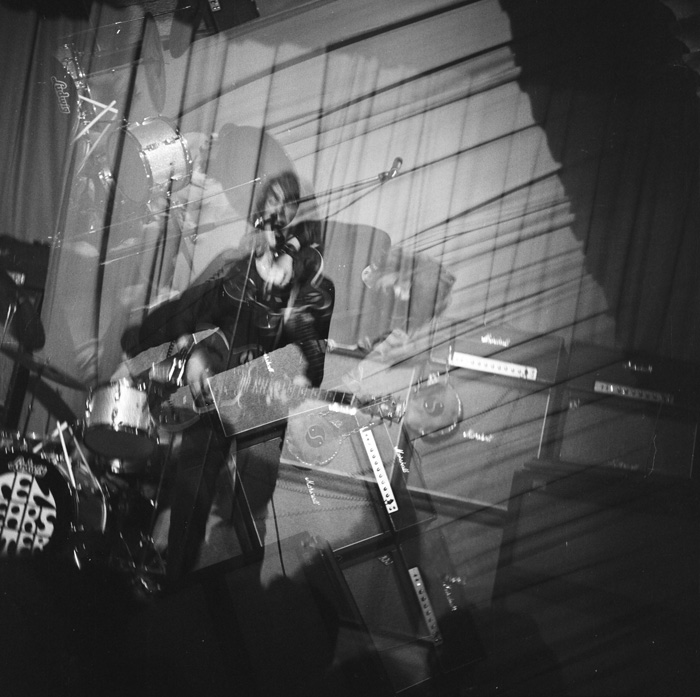
Photographer:
Fizzè
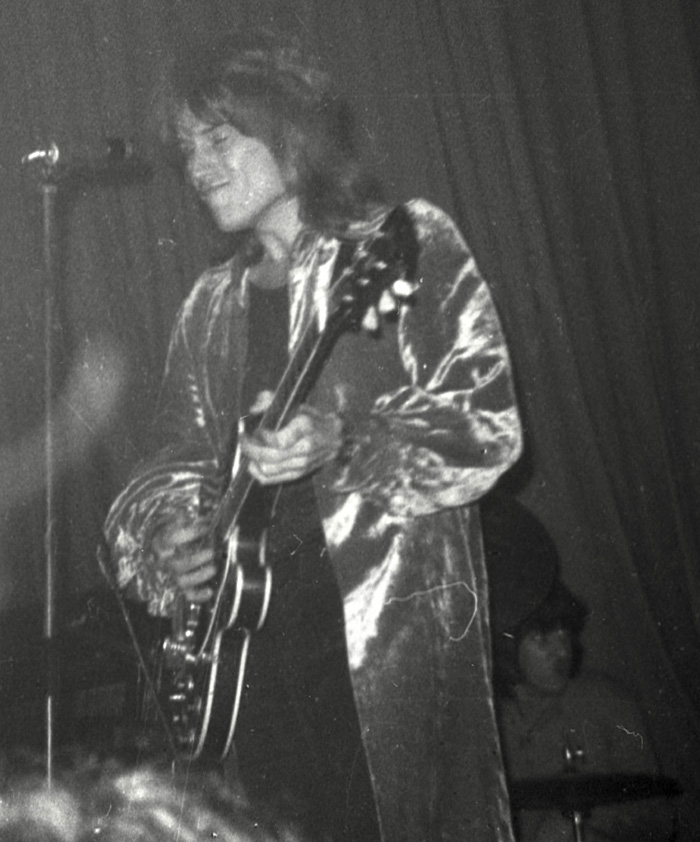
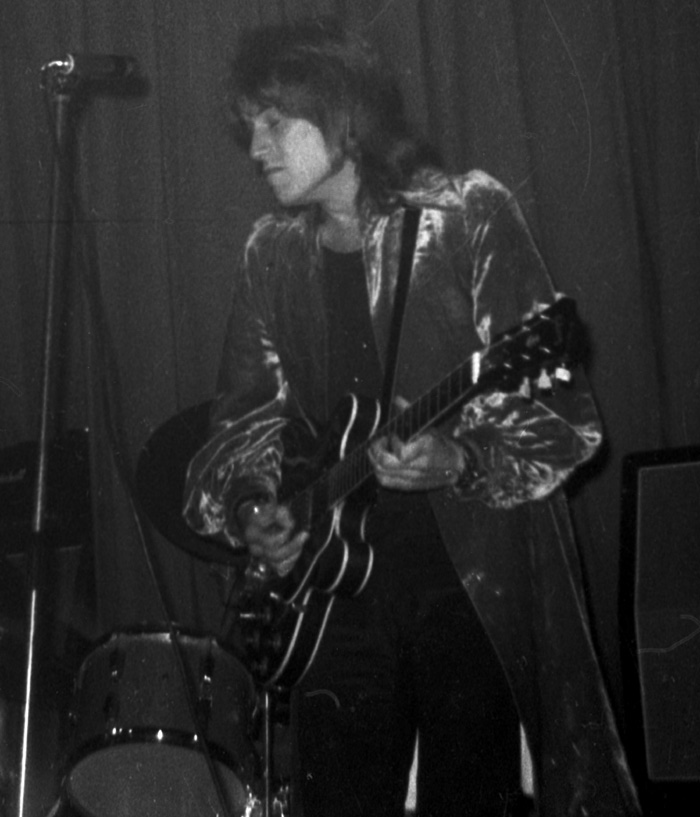
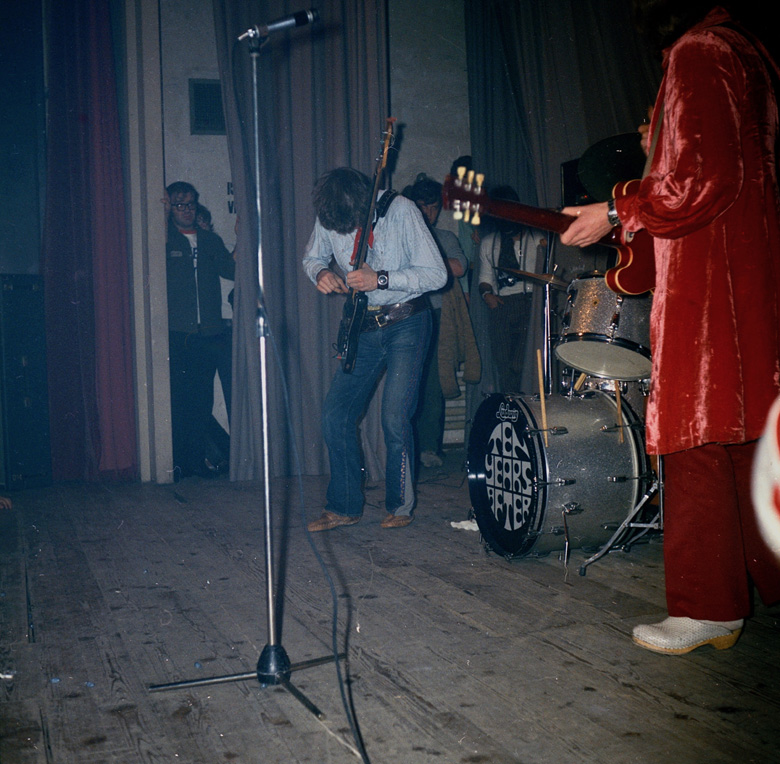
John Hembrow - far left
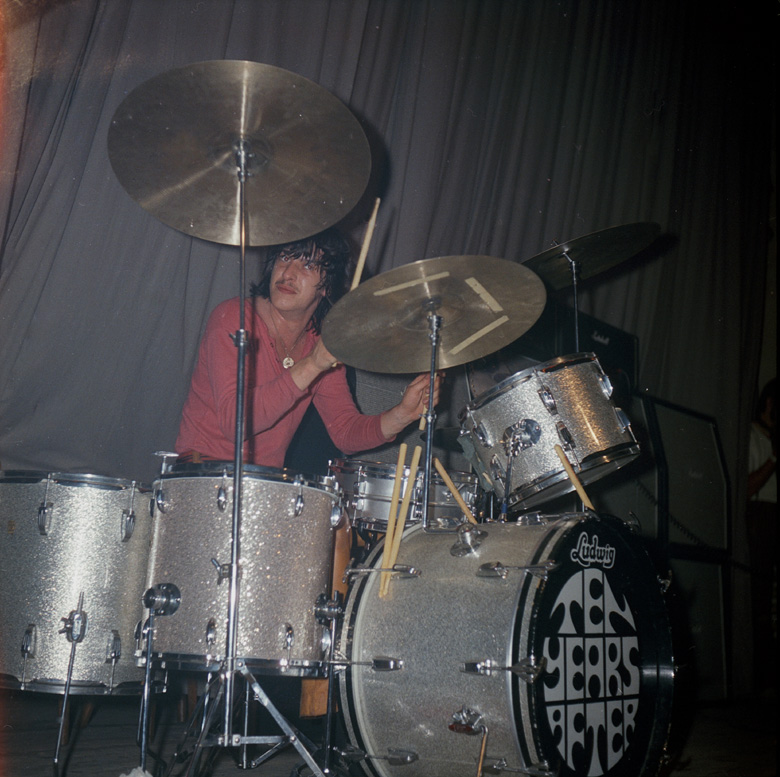
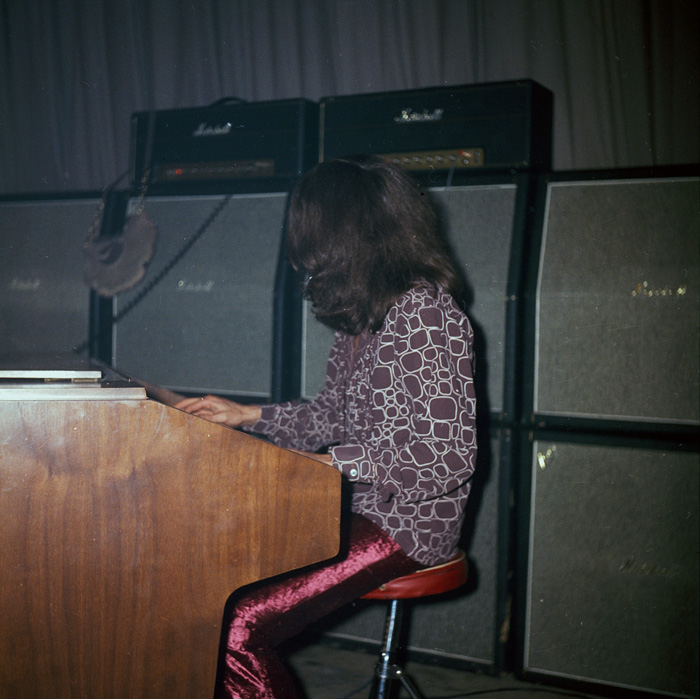
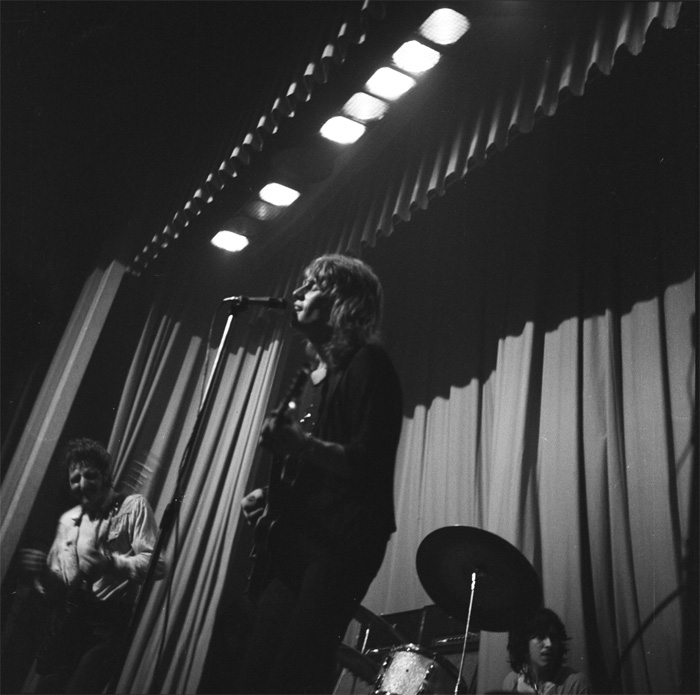
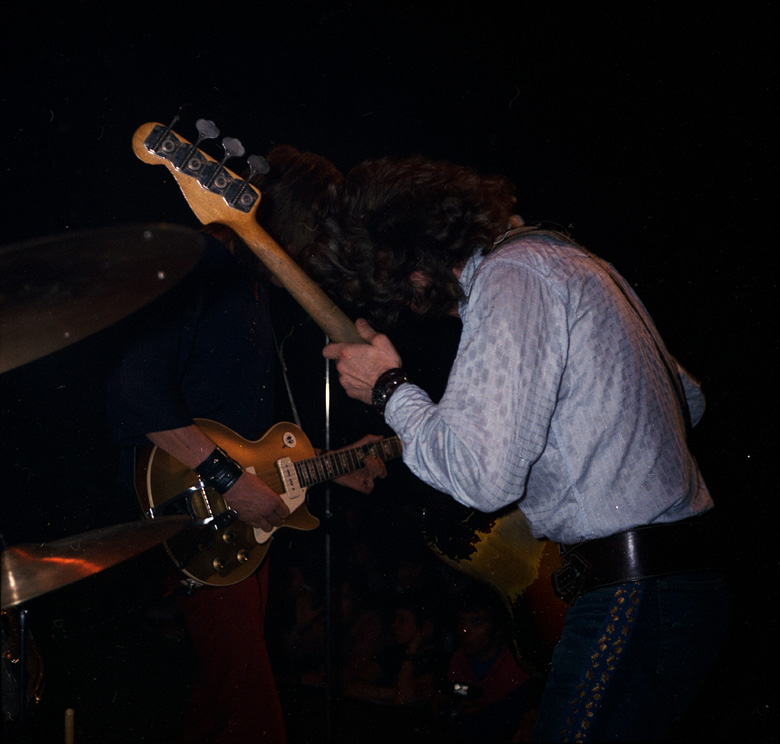
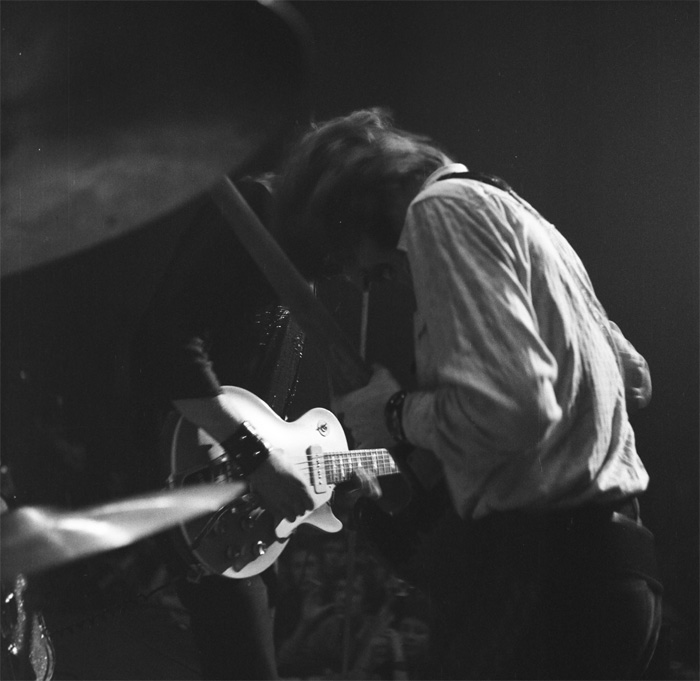
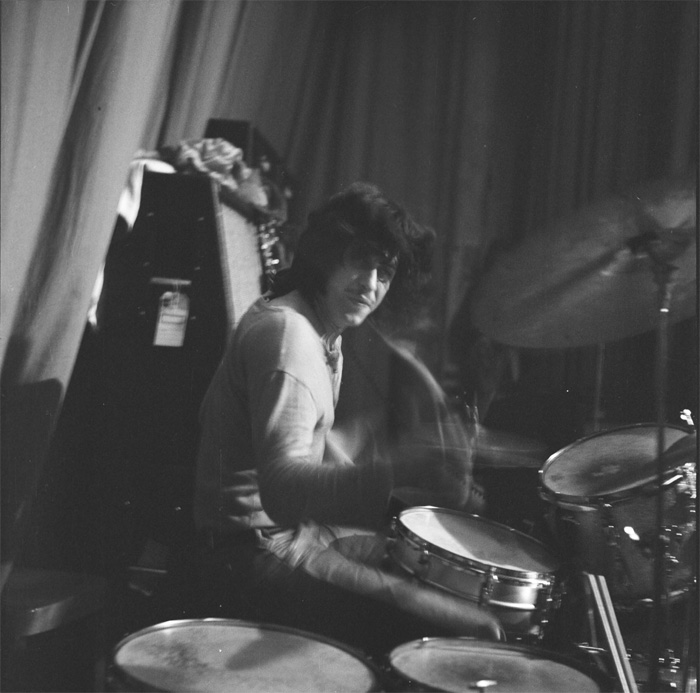
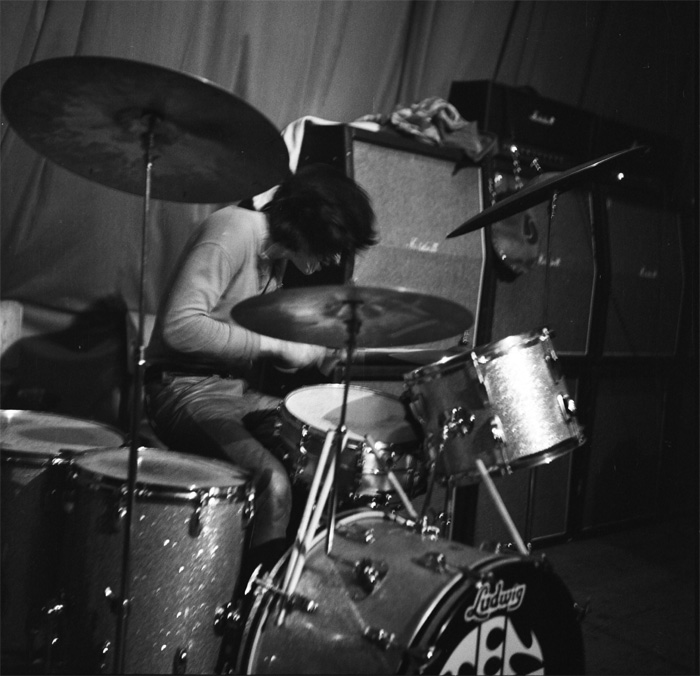
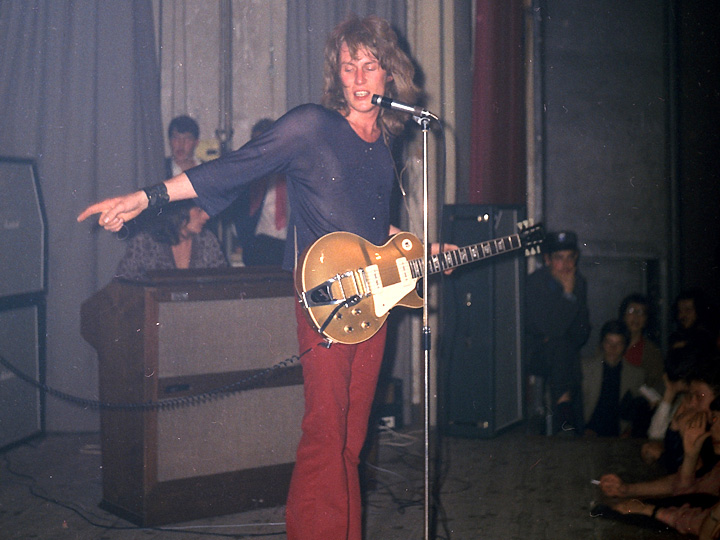
Alvin Lee with Gibson Les Paul
Gold Top - pointing to Leo Lyons
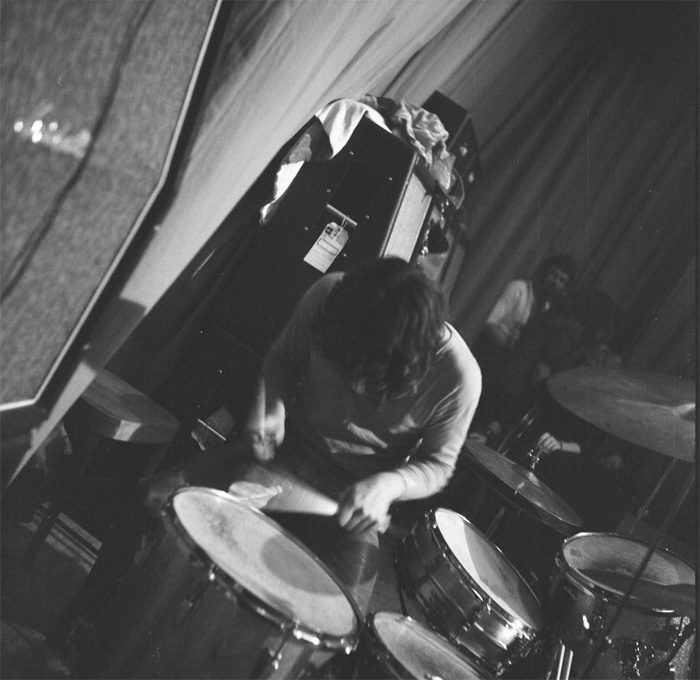
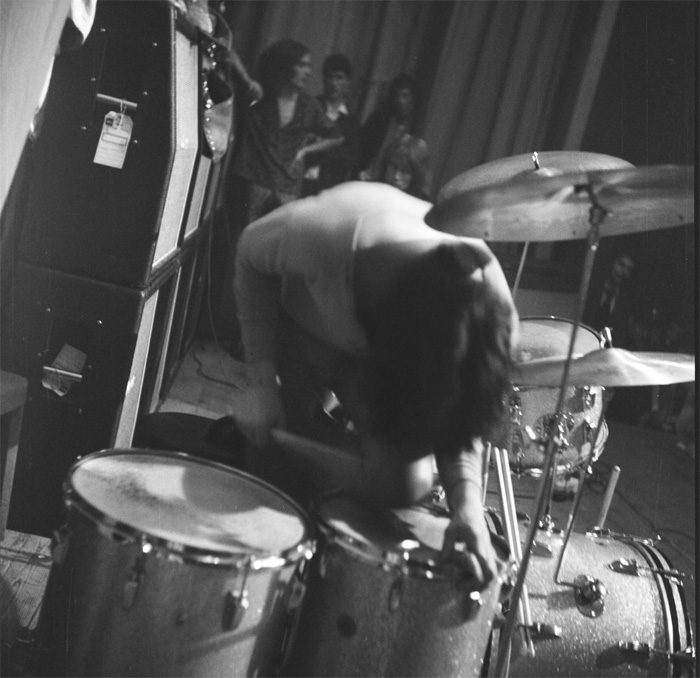
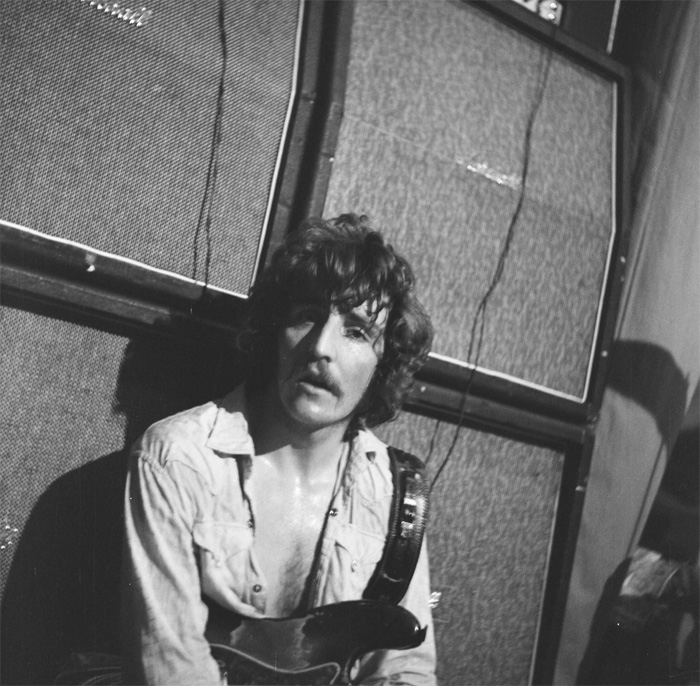
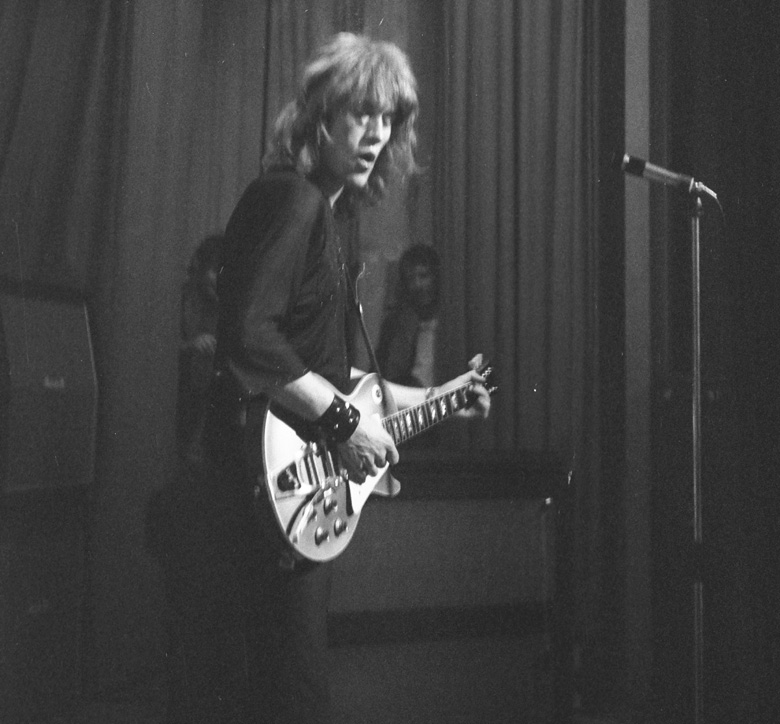
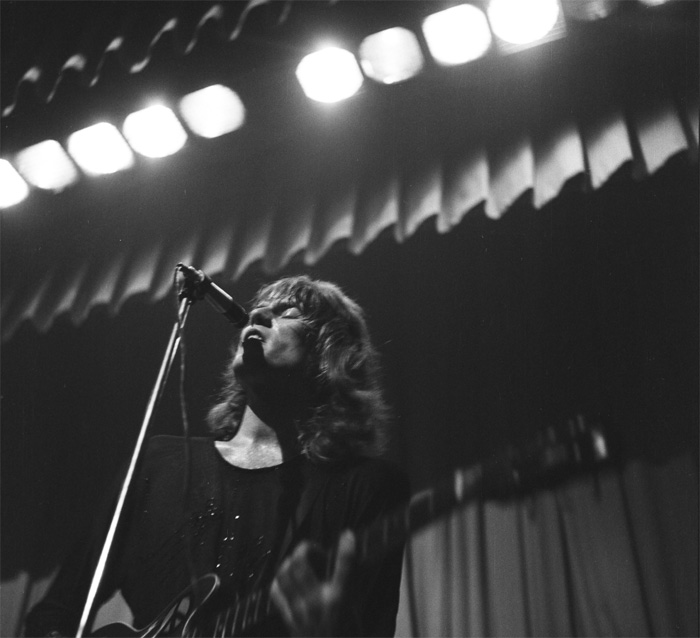
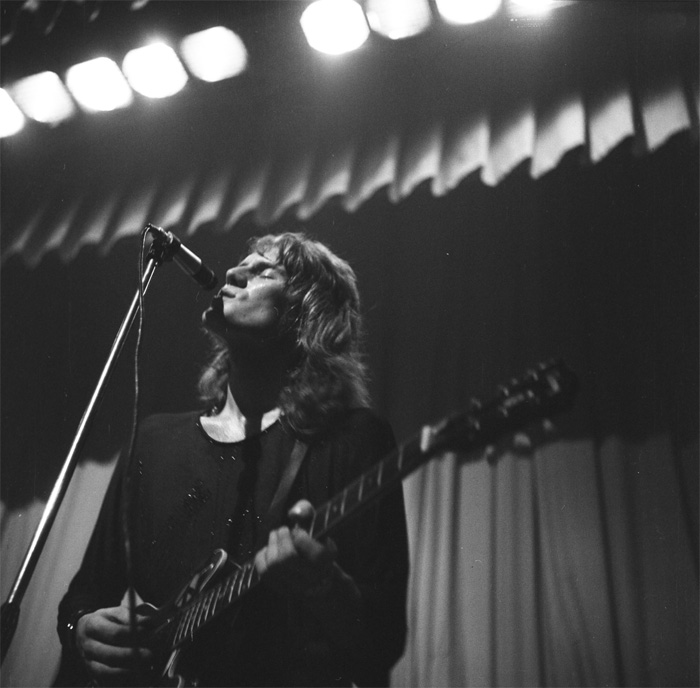
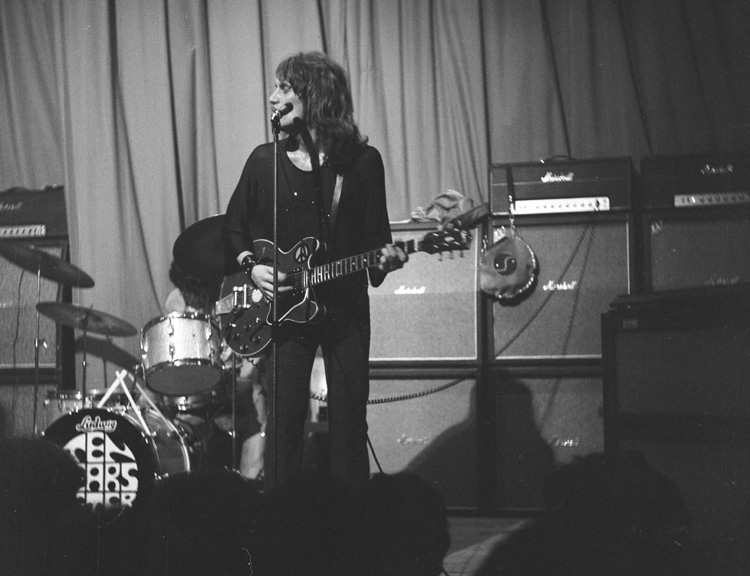
Andy Jaworski - fourth from left
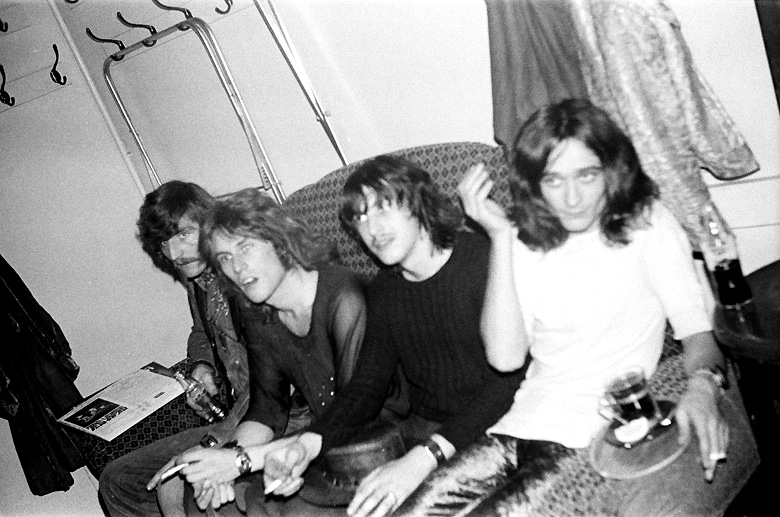
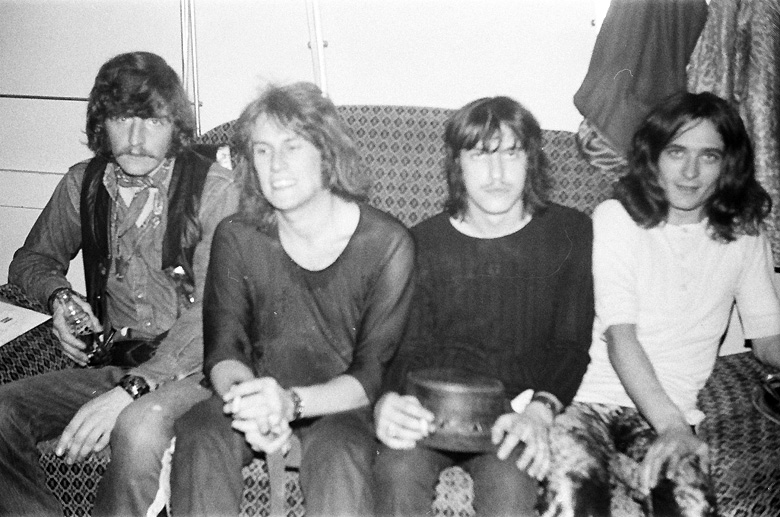
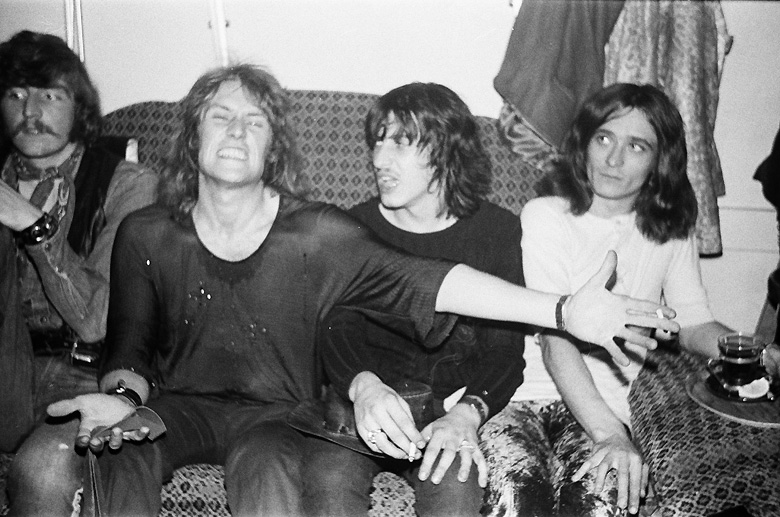
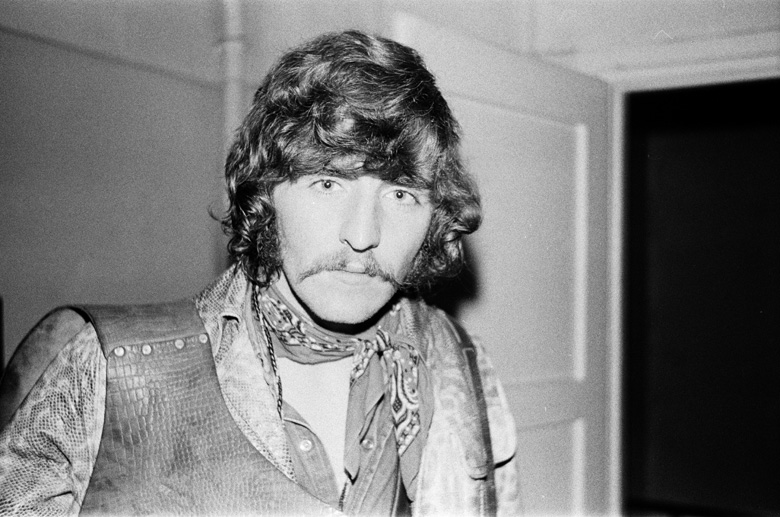
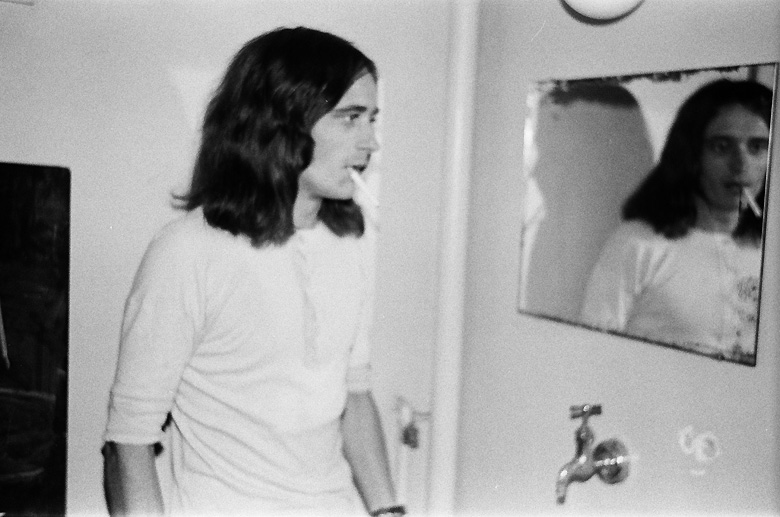
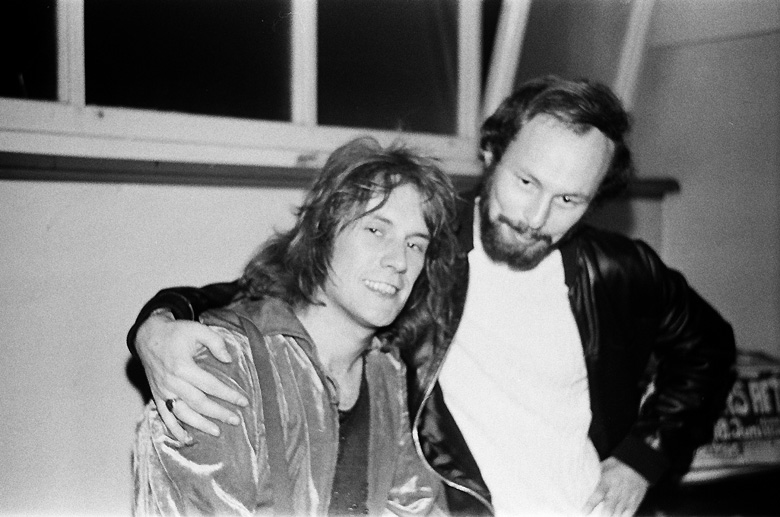
Alvin Lee, Christ Wright

TYA signatures in Fizzé's photo
book
Photographer: Fizzè
https://mensch3000.ch
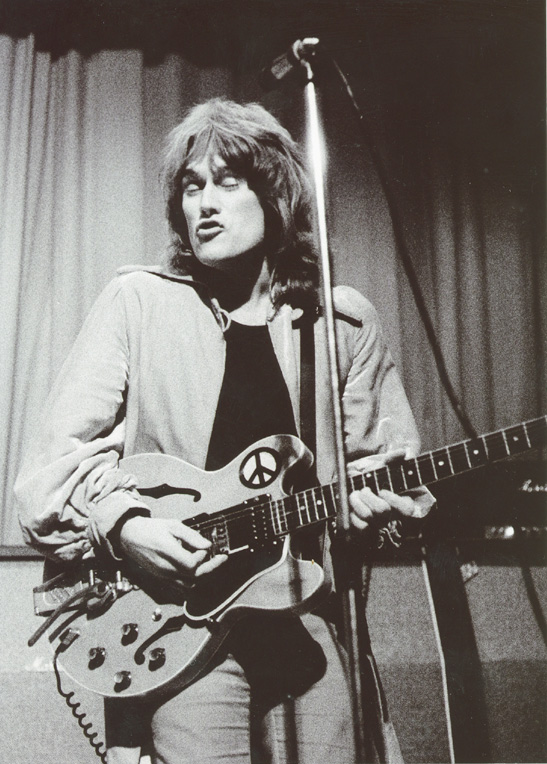
Photographer: Urs
Blumer
www.ursblumer.ch

June 19, 1969 -
Albisriederhaus, Zürich, Switzerland
Photo by Eric
Bachmann

Backstage Photos
- by Eric Bachmann
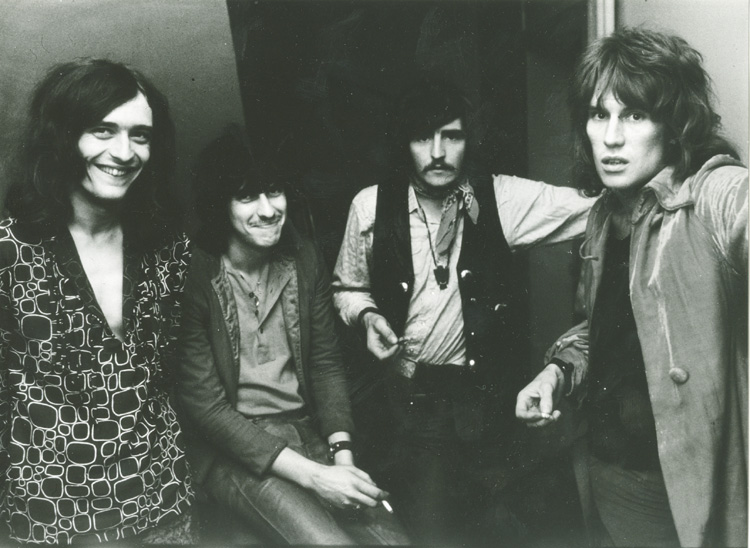
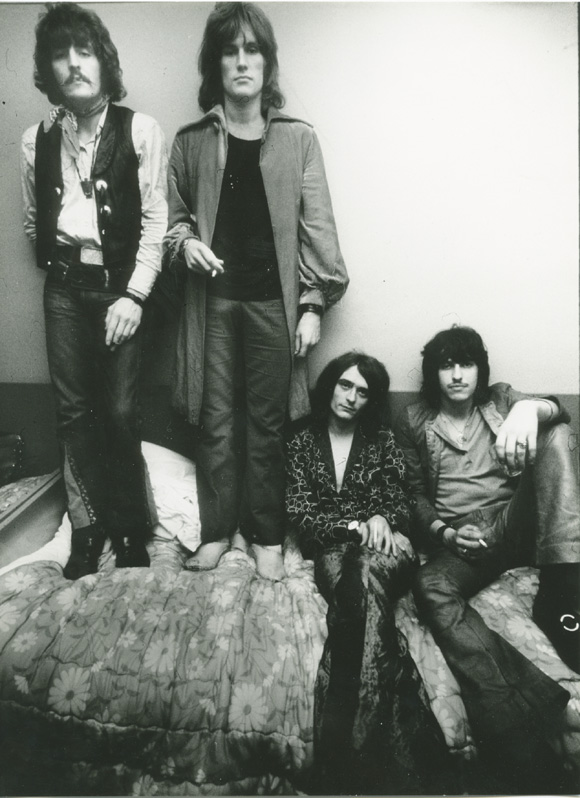
Photographer: Eric Bachmann
https://ericbachmann.ch/
|
1969 June 18 - 22 - MONTREUX JAZZ FESTIVAL,
Switzerland /Suisse
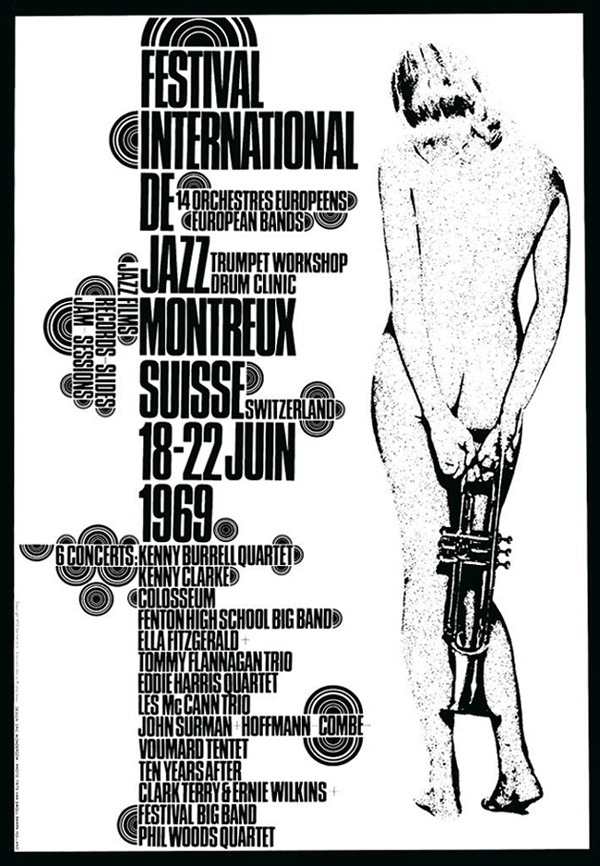
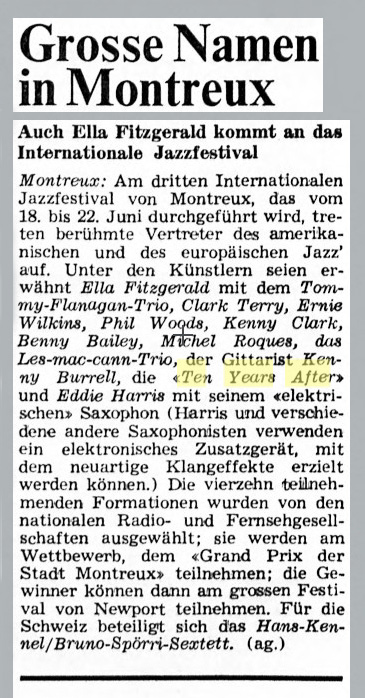
The above contributions by Tonny Steenhagen
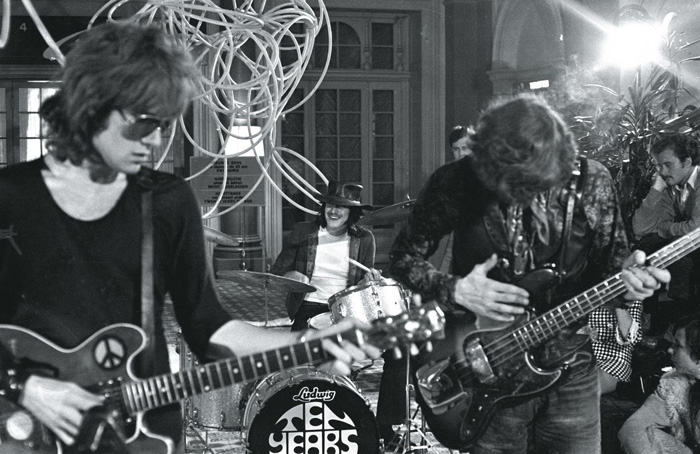
Montreux Jazz Festival, 20 June 1969
- Photo by Francois Jacquenod
|
POP MAGAZINE 1969
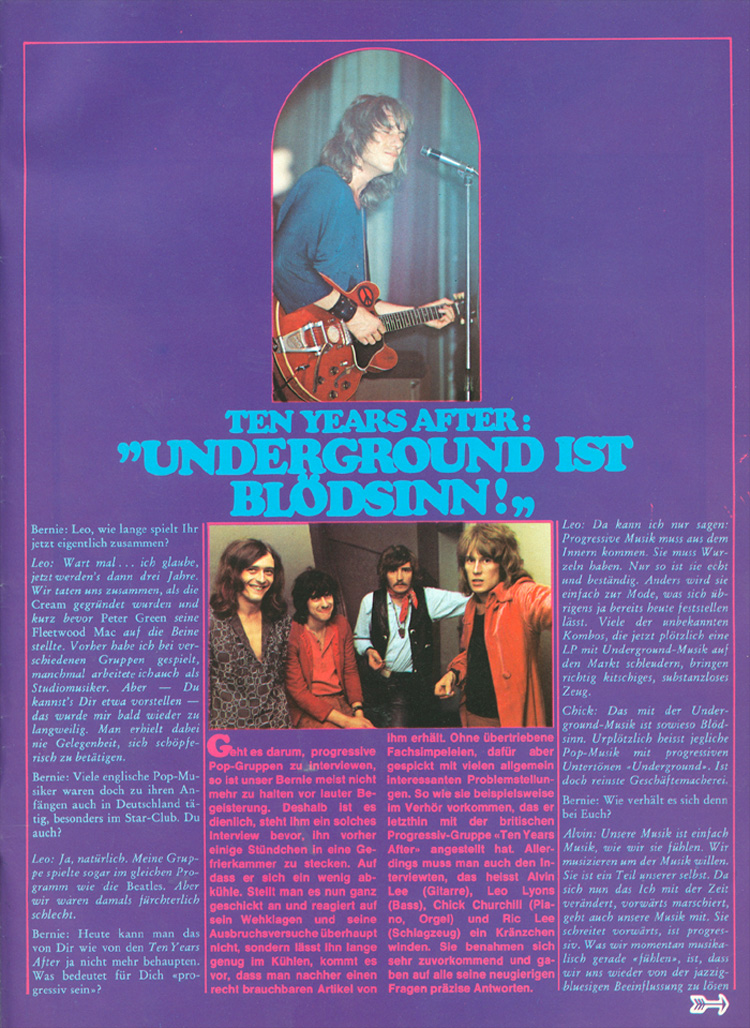
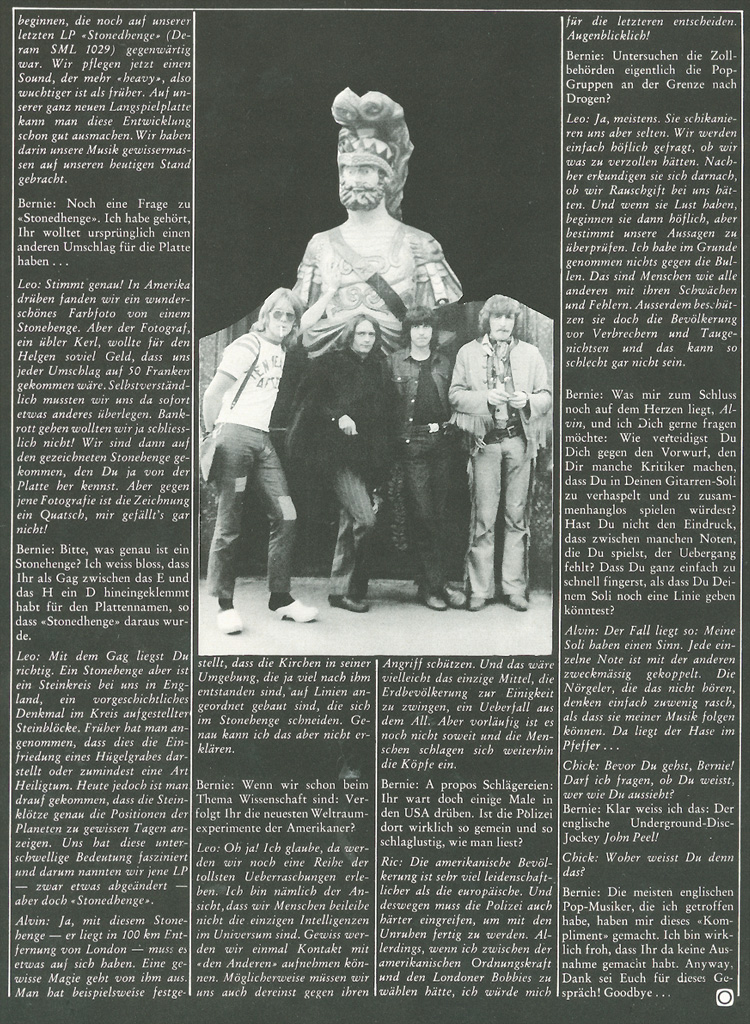
|

Ten Years After - Spring
1969
|
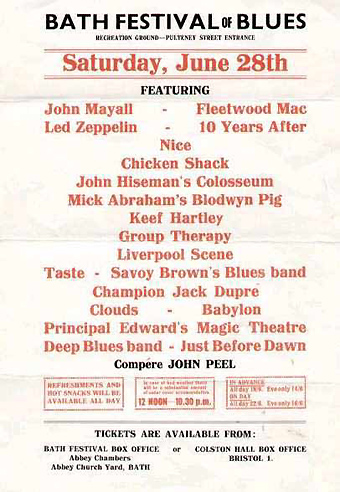
JUNE 28, 1969
- BATH FESTIVAL OF BLUES

The
1969 bash only attracted 12,000 punters, and has in general been
overshadowed by its far bigger and younger sibling festival of
1970.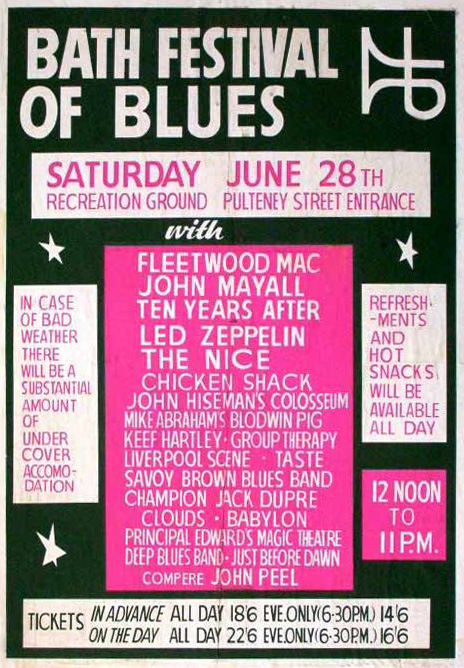
Less
than two months (about 48 days) before the famous “Woodstock
Music and Arts Fair” August 15, 16, and 17 – there was the
“Bath Festival”.
Ten
Years After, featuring the pyrotechnical guitar skills of Alvin
Lee. Ten Years After came into world wide prominence in 1969,
after their blistering performance at Woodstock. There is no
doubt in anyone’s mind, that Alvin is an excellent guitarist,
but their lack of ability to write strong tunes was a distinct
problem because, one cannot forge a long term career on
blindingly fact solos alone. The really great musicians (guitarist
in this case) move on to develop their own style and sound,
which is something that Ten Years After failed to do.
It’s
more than likely that this one factor alone caused the bands
final decent into a long term, Semi-obscurity
and Semi retirement of sorts. While
many other bands from the 1960’s who are now defunct, have had
a much larger following.
At
the Bath Festival, it is reported that Ten Years After were the
last band to perform there.
They
also played their showstopper “I’m Going Home” to close
out their set and performance at Bath. Their set lit contains
the following songs:
- I
Woke Up This Morning – 8:10
- Good
Morning Little School Girl – 7:00
- I’m
Going Home – (It should be duly noted that the entire
bootleg is of very poor quality. Also, I’m Going Home is
not on this recording.
Their
performance according to one fan says: The
usual Alvin Lee pyrotechnics, playing rather too much, and
rather too fast for my personal taste.
Newspaper
Article:
The
four entrances were crammed with the fans from all over the
country. Most had patiently queued for their tickets, but some
attempted to climb the fences and were stopped by police and
stewards. Radio One’s D.J. John Peel called on the crowd to
impress the authorities, that they were in the city for a great
event, and to show they were well behaved. Mr.
Fredrick Bannister, the concert promoter, was looking very happy,
and was counting on an attendance of at least 15,000. One
group who hitch-hiked from Coventry said, they saw at least a
thousand fans making their way to Bath. Some others from
Coventry, who travelled by train were forced to go via, London
to reach Bath, because of a “Lightning (Labour) Strike by
Birmingham rail men yesterday. One said, “We got a lift in a
dry cleaners delivery van, to reach Bath, we went two hundred
miles out of our way, helping the driver at his various delivery
points. But he was a Bath man, and he brought us early right to
the ground. Many
of the overnight visitors took busses and cars into the country
to find fields in which to sleep. The tow path alongside the REC
( Recreation Grounds) was cluttered with tents. There were no
real hitches (problems) John Peel in introducing the first group,
“Just Before Dawn” (is the name of the band) says, “All
the groups are here, and there do not seem to be any hang-ups.
The
People Speak Out:
The
Reverend Norman Veysey from
Somerset, England said, “It’s good clean fun, They
look like a crowd of very good young people”.
“This
event is something that we have to cater for in this generation.
Provided it’ s organised on the proper lines, and every
precaution has bee
taken, and these people don’t get mixed up with leather
jacketed beatniks, these hippies should be quite peaceful. They
add colour to an otherwise drab scene. It’s the outside
element that’s the danger”.

June 28, 1969
-
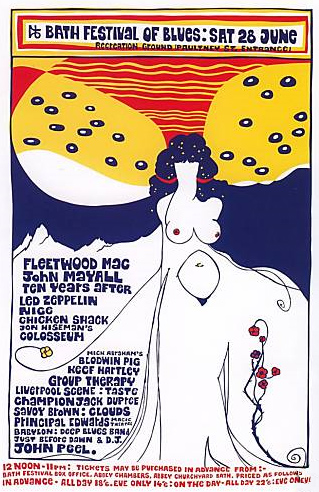
Record Mirror Report
The Bath-Festival of
Blues was no picnic for the poor kid stranded in the middle of
the football field and badly in need of a public convenience. As
one peered out on a veritable sea of heads (pun?), it appeared
as if there were two or three more hippies than blades of grass
on the field. 40,000 or more raving music buffs migrated to the
site on Saturday the 28th via train, plane, car, foot or
meditation to see the vast line-up of acts, which included among
others, Fleetwood Mac, Lep Zeppelin John Mayall, Keef Hartley
Band, the Nice, Roy Harper (?), Chicken Shack, Liverpool Scene
and a never~ending list of others. The stages (two) were barely
visible from the opposite end of the field, but the sound was
audible throughout the grounds. Hot dogs were being consumed
with gusto and there was a run on the ice cream van which put
poor old Luigi under great stress. People shuffled through
mile-long queues, forget-ting half way, what it was they were
queueing for. A space forty feet from the stages was worth its
weight in Watney's.
The great teeming
hordes behaved exceptionally well with the frequent Persuasion
Of Johm Peel and Mike Quinn. It was a great day for armpits and
whiskers and not an idle one musically. Led Zeppelin and the
Nice appeared to have stolen the show, but all the other acts
were received with voluminous applause. The only incident
occured during John Mayall's set when one monumental idiot who
had been annoying the crowds and bands for hours. chucked a
bottle and was promptly chucked in return. Things otherwise were
handled well by the genuine people who came down to hear some
good sounds. Chicken Shacks man with the 200ft. Iead, Stan Webb,
had this to say: " It was an
exceptionally good festival, but I think they should have
erected a scaffold or bleachers in the back so all of them could
see. Also the bar went dry!"
"We're not supposed to drink, so the bar doesn't affect us
(cheesy grin,)” said Zeppelin's lead singer Robert Plant,
"The only drawback to the show was the short sets. We have
trouble with short bits because you can't connect as people
unless everybody has a chance to do their solo. But still. there
were a lot of acts to go on! "
A lot of people got
well tanned in the sun with the music going through their ears.
It was a big day for the exciting town of Bath and as the great
migration north started late in the evening, apprehensive
Pensioners could be seen standing in doorways casting the heavy
eye on the passing crowds and thinking, 'Whats it all about?
Arrrrrr'
|
|
July 3 - 6, 1969 -
Newport Jazz Festival
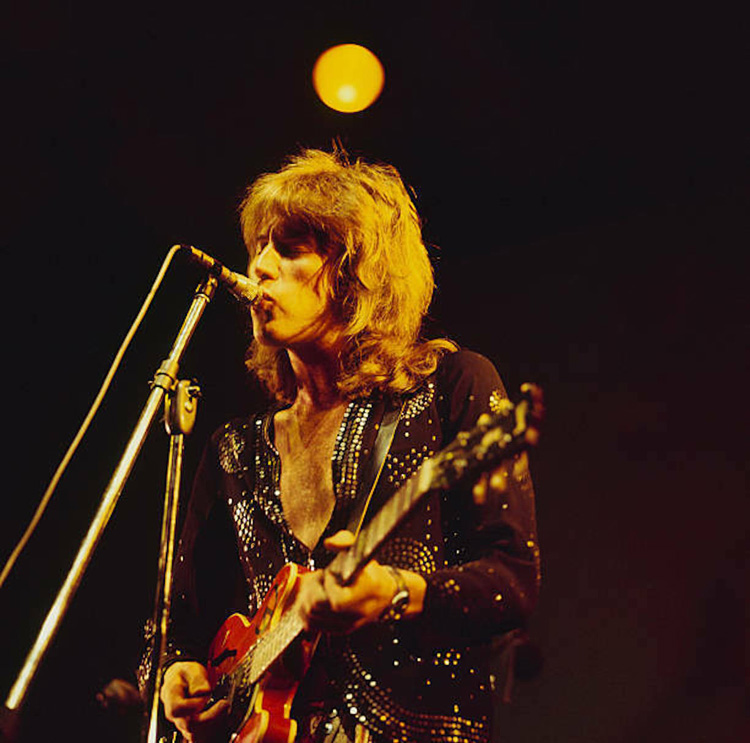
Newport Jazz Festival -
Photo: David Redfern


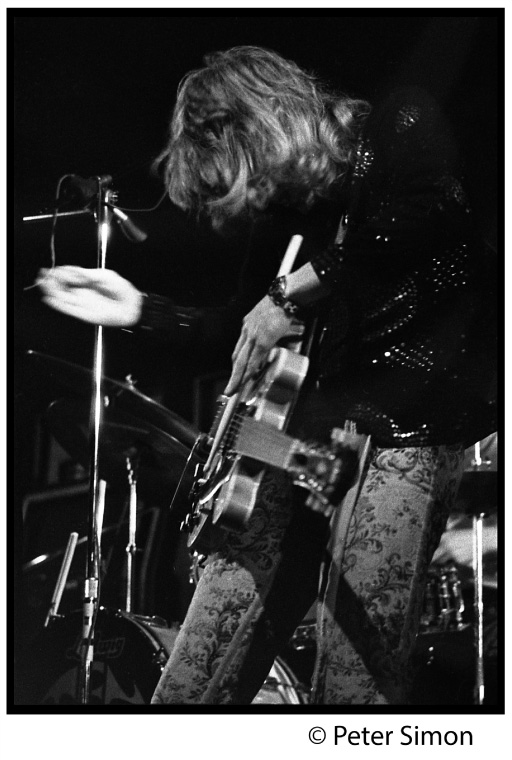

Newport Jazz Festival -
Photo: Peter Simon
|
|
July 4, 1969 - Newport
Jazz Festival 1969
From Barry Lazell:
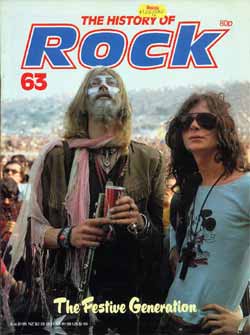
The History of
Rock – Volume 6, Issue 63 - Published In 1985
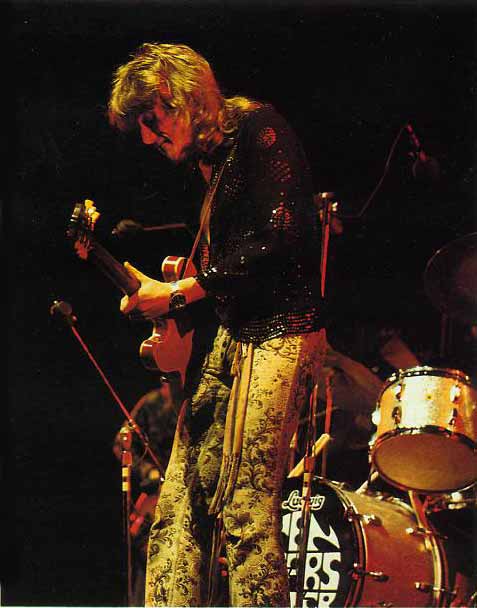
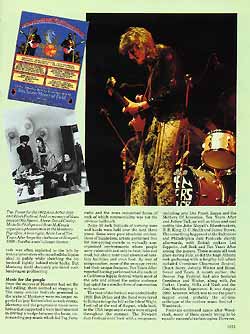
The caption beneath Alvin Lee’s photo reads as follows: “Alvin Lee of Ten Years
After keeps his clothes on at Newport 1969, but this wasn’t
always the case”. The Newport Festival took place on July 4,
1969 – Rhode Island, New York. The set list for Ten Years
After included:
1. I May Be Wrong, But I Won’t Be Wrong Always
2. Good Morning Little Schoolgirl
3. Help Me
Music For The People:
Once the success of
Monterey had set the ball rolling, there seemed no stopping
it. The many similar festivals promoted in the wake of
Monterey were no longer regarded as “POP” festivals, but as
“Rock Events”. Monterey and the progressive music were
instrumental in driving a wedge between the basic
un-demanding pop music which fed “Top Forty” radio, and the
more committed forms of rock of which commerciality was not
the obvious hallmark. Some thirty rock
festivals of varying sizes and kinds were held over the next
three years. Some were pure
idealistic celebrations of “Hippie Dom” where artists
performed for free, for non paying audiences, in virtually
non-organized environments, where people were vulnerable not
only to heat, rain and mud, but also a near – total absence
of sanitary facilities and even food. By way of
compensation, some of the on stage events had their unique
features; Ten Years After reported having performed totally
nude at a California hippie festival, where most of the acts
and almost the entire audience had opted for a similar form
of communion with nature.
In the U.S.A. large
scale events were staged throughout the summer of 1969. The
Newport Jazz Festival went “ROCK” with a vengeance,
including acts like Frank Zappa and The Mothers of Invention
– Ten Years After and Jethro Tull, as well as blues and soul
outfits like John Mayall’s Bluesbreakers. B.B.King,
O.C.Smith and James Brown. The same thing happened at the
Baltimore and Philadelphia Jazz Festivals shortly
afterwards, with British rockers Led Zeppelin, Jeff Beck and
Ten Years After among the jazzers. These events all took
place during July, as did the huge Atlanta rock gathering
with a lengthy bill which included: Creedence Clearwater
Revival, Chuck Berry Johnny Winter, Joe Cocker, Crosby,
Stills and Nash, and the Jimi Hendrix Experience. It was
August 1969 however, which was to see the year’s biggest
event, probably the all time archetype of the outdoor music
festival Woodstock.
Festivals continued
apace after Woodstock, many of them openly trying to be
equally successful carbon copies. However, Woodstock’s free,
spontaneous spirit never arose again in the same way,
although it was constantly being evoked. The only event to
come close was the 1973 Watkins Glen Festival in New York
State, where the attendance figures of 600,000 broke the
previous Woodstock attendance record of 500,000
respectively. Three bands appeared at Watkins Glen: The
Grateful Dead – The Band and The Allman Brothers Band. It was the Rolling
Stones appearance at The Altamont Speedway in California
that sealed the fate of the giant rock festival and the end
of the 1960’s along with it.
Text Was Slightly
Edited by Dave – Facts Remain Unchanged.
Newport 1969 – The
Year Rock Was Invited To Invade The Jazz Festival:
George Wein was
tired of the avant-garde jazz movement and envisioned rock
music as a translation of the blues and thus an extension to
the roots of jazz. For the festival, he labelled this music
as “Jazz – Rock”. He placed Led Zeppelin right along-side of
Herbie Hancock and B.B.King with Jeff Beck and Jethro Tull
with Rashaan Roland Kirk – Anita O´ Day – Sun Ra and James
Brown. “It was the Friday night show which was the most
extraordinary of concert experiences. Jethro Tull, Ten Years
After, Jeff Beck with Rod Stewart and Ron Wood on Bass –
Blood Sweat and Tears – Rahsaam Roland Kirk, who was the
best of them all.
Over 85,000 ticketed
guest, the audience broke the record from all previous jazz
festivals throughout the sixteen year span. Wein, right from
the start wanted to control the divergence of jazz into
avant-garde dysfunction. He created an avenue into a scene
that vibrated with enthusiasm, innovation and musical
structure – revolution over capitulation. The problem became
– that the jackhammer of rock (which plays second fiddle to
no one and nothing besides) had cracked the very foundation
of the music he (George Wein) had loved so much and for so
long. In fact, in later years George admitted with heartfelt
sorrow, that allowing rock into the festival was his
mistake. “I still consider it the nadir of my career. I
agreed whole-heartedly with Dan Morgenstern (writer for Down
Beat Magazine) – when he wrote the following: “The rock
experiment was a resounding failure”. It has been pointed
out that, the rock audience is mostly about superficial
posturing, while the jazz audience is more concerned about
intellectually and emotionally absorbing the vibe on a much
deeper level as intended.
The 1970’s Newport
Festival would salute Louis Armstrong and the other veterans
of jazz music. Although rhythm and blues and soul would work
their way into the festival line up, the doors were closed
where rock and roll was concerned.
George Wein always knew how to pick the very best in music
and the musicians who made it.
|
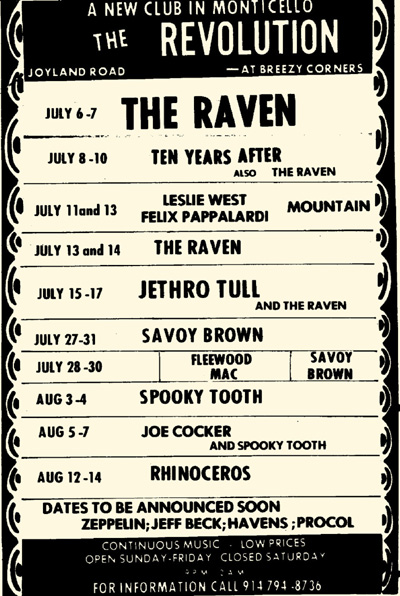
July - August, 1969 - The Revolution,
Monticello, NY
July 11, 1969 - Spectrum Summer Music
Festival, Philadelphia
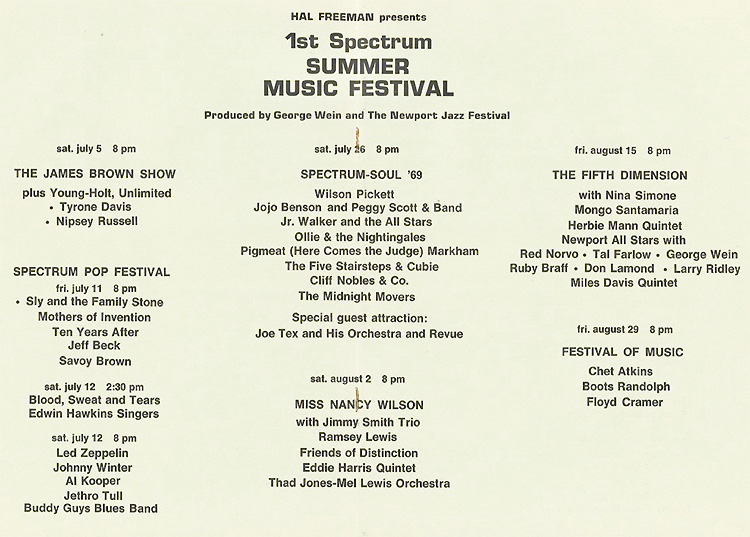
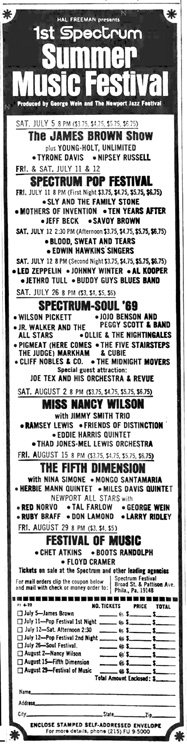
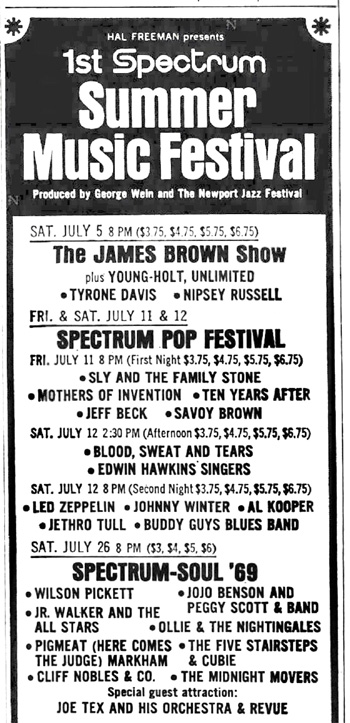
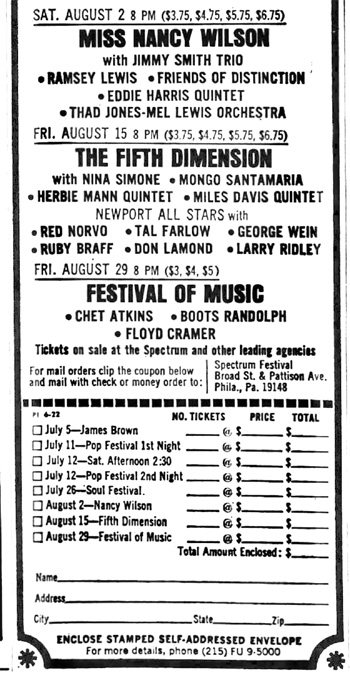
|
New Musical
Express July 12, 1969
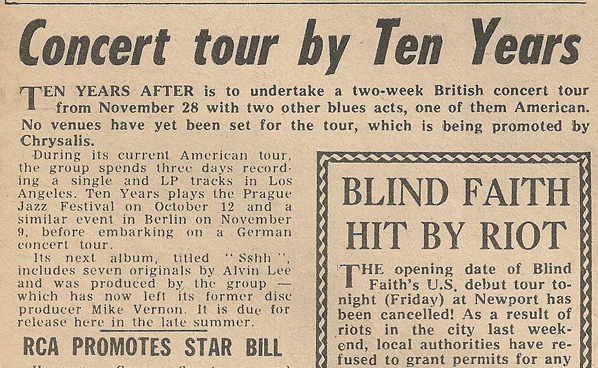
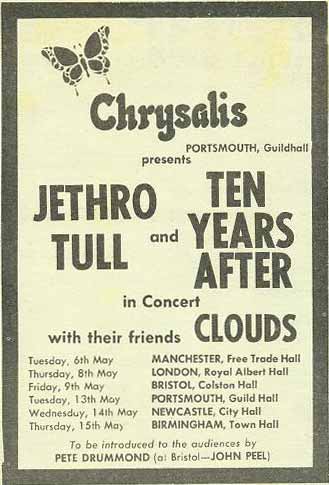
Concert Tour By Ten Years After: July 12, 1969 – From New
Musical Express:
Ten Years After is to undertake a two-week British Concert
Tour from November 28 with two other blues acts, one of them
American. No venues have yet been set for the tour, which is
being promoted by Chrysalis. During its current American
Tour, the group spends three days recording a singleand LP
tracks in Los Angeles. Ten Years After plays the Prague Jazz
Festival on October 12, and a similar event in Berlin on
November 9, before embarking on a German Concert Tour. Its
next album, titled "SSssshhh" included seven originals by
Alvin Lee, and was produced by the group, which has now left
its former disc producer Mike Vernon. It is due for release
here in the late summer.
|
HIT PARADER MAGAZINE FROM JULY 1969 PRICE 35 CENTS
ONE MONTH BEFORE THE WOODSTOCK FESTIVAL SPECIAL GUITAR
ISSUE
TEN YEARS AFTER ALVIN LEE - LEAD GUITAR - Fastest Guitar In
The West
Alvin Lee: I was born in 1944 in Nottingham, England which
is also where Robin Hood came from - the Sheriff of Nottingham
and all that. I left home for London at the age of fourteen.
London seemed the only place to make something of myself. I
joined a rock and roll band when I got there and started to
take care of myself.
My favourite kind of music was country blues and jazz and I
went to all the nightclubs in London to hear my favourite
musicians. One day I met Big Bill Broonzy in a club and that's
what started me off really. I went to see him every night. I
was playing clarinet at the time in a little club band - just
regular standard tunes. That's where I learned the rudiments
of music. The proper way to play things.
There was always a guitar around the house and I learned
chords from different books. Back then, I loved the country
rock style of Scotty Moore, with Elvis, and that led me to
Chet Atkins and I found it very clumsy for quite awhile. I
learned all the conventional ways to play, the tuning and
everything. Occasionally I use a straight A tuning.
When I first used an electric guitar it wasn't good to
obviate the distortion or feedback. It was just for a good
clean sound. A few changes have gone down since then. After
playing in bands for so long, I got more and more interested
in amplification and the various sounds. About four or five
years ago I experimented with this and had some special things
built for me, but now I've got Marshall equipment, straight
tops and bottoms. I have a Gibson guitar that I had re-wired.
I put another pickup in it and it has more range from bass to
treble.
Ten Years After was established as a blues band. I had
known Leo our bass player foe nine years. We played on and off
in various bands. We got together in London finally as
recording session men. We did a lot of rubbish together. Then
we went on the road doing backup work and we met Chick. The
three of us decided to get together as a group to do sessions
and we were quite successful. We played every type of music
imaginable. We did lots of super clubs with songs like "How
High The Moon", "Lover" and stuff like that. We
had a lot of work but we grew rather bored and wanted to do
something more adventurous.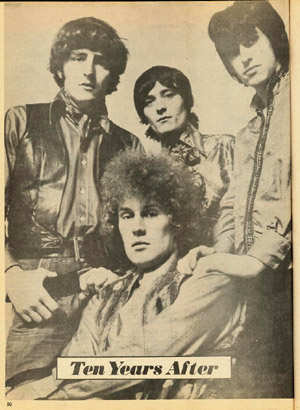
I listened to all types of guitar players from Spanish
classical to Chuck Berry to Django Rheinhardt and took a
little from each one. I might sound like certain players, but
now I'm to the point where I sound like many different players
in one song.
So we decided to get into blues heavily. At the time, we
were the heaviest thing going in England. We were very happy
with it because we really dug it. I don't know why it caught
on, but we developed a following right away. Maybe it was
because we were playing music we believed in. It might seem
that there's a big blues thing happening in England. It's no
better than the States actually. Most British bands are doing
better outside of England. Like, we have a good thing going in
Sweden and Denmark. In England the blues audience is too
strict. There are people who only want Elmore James songs and
won't touch modern blues or country blues and then there are
strict country blues fans. You can't find an audience in
England that digs all kinds of blues. American audiences seem
to dig a good feeling from any kind of music. In England it's
an intellectual thing.
We're not going to jump into an other kind of music. We've
been quite successful playing jazz-blues so our progress will
be very slow. It would be hard to change our stage music, but
on albums we can do different things. On an album we can use
the studio. That's just a side trip. Personally, I feel my own
style, my own music moving into a new place. I'd say it's
getting more spiritual in that it's coming from my
subconscious. I can leave the conscious mind and fingers and
play flashes of ideas, whatever I think of. I can play
whatever I think of - the right phrases - but I want to think
of the right things. You can fall into patterns, like B.B.
King is a stylist and I can feel exactly what he's going to
play next. He's got thousands of riffs, but I can hear them
coming. I don't knock that but I want to do something
different. I hate hearing myself play the same thing every
night. The thing is to play from my mind and not my fingers.
Sometimes I'll know my instrumental break is coming and
I'll already hear the licks and riffs. I don't like that. I
want to play things from nowhere. Just let it come without
thinking. But this is my personal trip. I try to modulate
between fast playing and slow playing. The speed in my playing
grew out of exercises. I found I could think of more things to
play much faster if I played fast.
The guitar will always be popular because it's the best
instrument for very vibrant music. It will go through phases
though. The Motown sound sort of phased guitars out in England
for a while. As a sessions man I just played chords behind the
band. Then organ came in all of a sudden and everybody had
Hammonds. Horns are around a lot more now too, but they can be
very limiting. It holds down the spontaneity of a band. If the
horns are spontaneous, they'll be doing boring riffs so they
have to be arranged to fit well.
I can play a great many types of music but I wouldn't want
to inflict my taste on the public. I'd just be showing how
virtuoso I am. I'm just happy that other people dig what we
dig to play. I like all kinds of music for different reasons.
There's technical music, pleasant music, emotional music. I
prefer the emotional. I love classical guitar, but to me
classical guitar isn't a good way of putting over classical
music. Electric guitar is the best way to put over anything.
I'd like to try it on electric guitar but I don't know if I
could pull it off. I don't think anyone would be interested.
Beefing up the classics would be a very difficult thing to do
and still keep the beauty of the music itself. It has to be
done very well.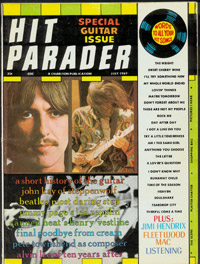
A musician is much more aware of sounds than the average
person. I like to get into detailed things, things with lots
of subtlety. I might hear a Pneumatic hammer and think it has
a good rhythm or a chord hitting a wall and echoing back. Our
new album has a song called "Stonehenge." It's a
good example of how I transpose a visual subject into music.
When I saw Stonehenge it gave me a definite inspiration. It's
very difficult to explain. Imagine looking up at a giant
redwood, touching it and seeing it and amplify that feeling
500 times. Stonehenge dates back to 1840 before Christ. It was
erected then and no one knows what for. Different tribes found
it and used it for various purposes. I've always been aware of
Stonehenge. I saw it as a child and many times since and I've
read books about it. There's another ancient place in England
called Gladstone that has these same weird vibrations. Flying
saucers have been spotted there. The mystery of these things
gives me a feeling which I transcribe into sounds.
Alvin Lee and Jim Delehant
|
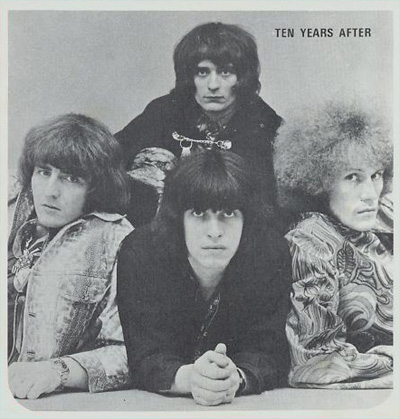
From ALPHABEAT Magazine - 1969
(pop, psych and prog rock 1967-1970)
Ten Years After Ten Years After are one of the most
successful of Britain's musically progressive groups in
America. The demand for them to appear there is so
overwhelming that they now work six months of every year there.
Formed in 1967, this four-man outfit first came to prominence
when they emerged as the stars of the 1967 Jazz and Blues
Festival at Windsor. Guitarist Alvin Lee, bass guitarist Leo
Lyons, drummer Ric Lee and organist Chick Churchill then began
to build up a formidable army of fans. Like the Who and many
groups before them they drew packed houses of discerning
audiences at London's Marquee Club and various other prominent
venues. The major breakthrough in their career occurred early
in 1968 when they first toured America. Demand was so strong
that they remained for twice as long as they had planned.
Following a short return to Britain, during which they
completed a "live" album at Klooks Kleek called
"Undead", they returned to America until the end of
the year. As far as the American critics and Underground radio
in the States are concerned, Ten Years After have filled the
gap left by The Cream. Alvin Lee in particular is venerated as
one of the most brilliant guitarist anywhere in the world.
Drummer Ric Lee produces some unique sounds by various
techniques and ingenuity, including his actually playing a
drum solo with a microphone. Chick Churchill, another fine
musician and versatile soloist, is the "raver" in
the group - he likes living it up and has become particularly
fond of an American drink called Southern Comfort. Bassist Leo
Lyons is steeped in the history of the old West, collects
firearms ( he has over three dozen) and intends to buy a ranch
in Arizona.
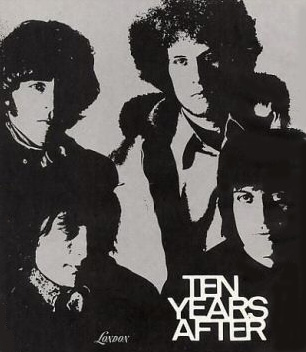
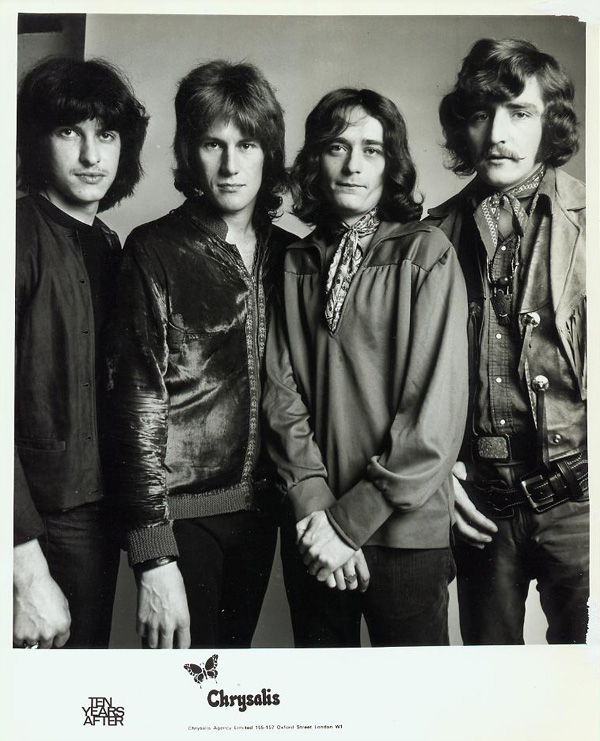
Line Up: Alvin Lee - Lead Guitar Born in Nottingham,
England December 19,1944 Five foot ten and a half inches tall.
Fair hair and green eyes.
Leo Lyons - Bass Guitar Born in Standbridge, England on
November 30, 1944 Five foot eleven and a half inches tall.
Brown hair and blue eyes.
Ric Lee - Drums Born in Cannock, England on October 20.
1945 Five foot nine inches tall. Black hair and brown eyes.
Chick (Michael) Churchill - Organ / Keyboards Born in
Flintshire, England on January 2, 1949 Five foot eight inches
tall, brown hair and blue eyes.
|
|
The Laurel Pop Festival 1969 – Ten Years
After
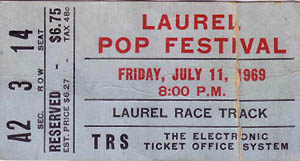
Location – The Laurel Race Course Laurel,
Maryland
Friday July 11 and Saturday July
12
Produced By George Wein and The Newport Jazz
Festival - Saturday July 12, 1969
Ten Years After began making music together
in England in early 1968, just in time to be caught up in the
resurgence of the blues sweeping that country and became one of
the prime movers in exporting and making the sound popular here
in the States.
Behind the music, are four English lads who
look like naughty school boys. Their names are Alvin Lee, Ric
Lee (no relation) Leo Lyons and Chick Churchill. They don’t get
together and make mischief though, just music. In fact they met
for the first time in a place as innocuous as a North Whales bus
shelter, and shortly afterwards found themselves playing the
first of many dates at London’s famous Marquee Club. Club
manager John C. Gee recalls how he sat in his office and heard
the strains of Woody Herman’s “Woodchoppers Ball”. John writes:
“Seized by curiosity, I entered the club and there on the stage
were these four guys, obviously having a ball. To this day I’ve
never discovered how they got there, and I’ve never bothered to
ask. I was excited by their playing and gave them a date at the
Marquee”.
After gaining attention in England they
toured the U.S. in July and August of 1968, meeting with
excellent audience and press response. As a result, their second
album “Undead” took off on the American charts. They were
immediately booked for a second tour which kicked off in New
York at the Fillmore East.
The Concert Bill: 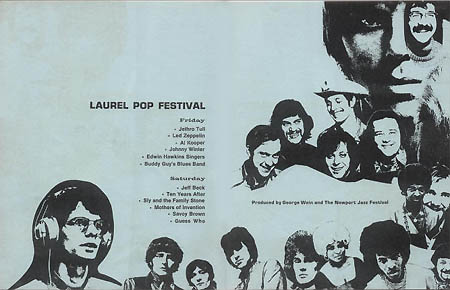
Friday Night - July 11, 1969
Led Zeppelin
Country Joe and The Fish
Jethero Tull
Al Kooper
Johnny Winter
The Edwin Hawkins
Singers
Buddy Guy’s Blues
Band
Saturday Night –
July 12, 1969
Sly and The Family
Stone
Ten Years After
and Jeff Beck
The Mothers Of
Invention
The Savoy Brown
Blues Band
The Guess Who
|
|
Ten Years After at the Singer
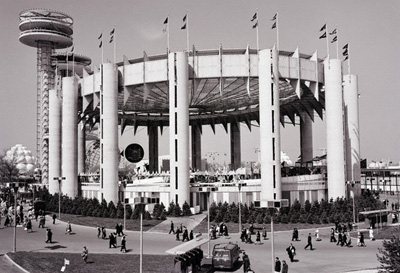
Bowl - July 13, 1969 – New York City
On The Old Worlds
Fair Grounds in Flushing, Queens.
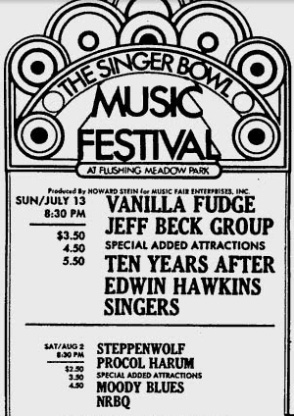
Led Zeppelin joined Jeff
Beck, Rod Stewart and Alvin Lee of Ten Years After on stage for
an encore of “Jailhouse Rock”, John Bonham played drums for Rice
Pudding. They performed at The Pavilion during the Singer Bowl
Music Festival. This was further substantiated from a press
review that was published shortly thereafter the event.
Press Accounting:
The Nine Man Jam –
Sunday July 13, 1969
Jeff Beck, Vanilla
Fudge, Ten Years After, The Edwin Hawkins Singers concert at the
Singer Bowl resulted in an unexpected “Jam Session” amongst
members of The Jeff Beck Group, Led Zeppelin, Ten Years After
and Jethro Tull. The music excited Zeppelin drummer John Bonham
to the point where he started tearing his clothes off. He was
carried off stage by friends before he could get past his
underwear. The concert roused the audience and pulled an okay
gross of $31,500 with a $5.50 top. The Pavilion and Singer Bowl
are being presented this year by Lee Guber and Shelly Gross.
Press Accounting –
From The Bridgeport Post
The Doors at the
Singer Bowl August 1968
Rotating Stages Suck –
The Doors perform on a revolving stage which breaks down part
way through their performance, and right in front of eye witness
Steven Peart. Steven was twelve years old at the time and
reports that a riot broke out with about two hundred teenagers
and students breaking up their wooden chairs just as the band
was completing its last two numbers. The audience ran for the
stage forcing the musicians to retreat backstage and having to
leave their equipment on stage. The students began smashing the
equipment using the wood sticks from their broken chairs, before
the guards could stop them.
There were approximately
one thousand people in the audience and they were already
aggravated because of all the time consuming delays due to the
revolving stage not working.
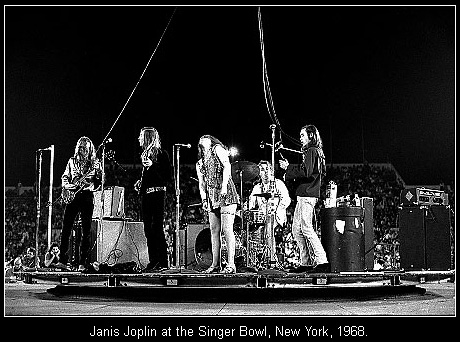
Photo by Thomas Monaster
The Who were on stage
right before the Doors, and the revolving stage got stuck during
their performance so that a quarter of the restless crowd
couldn’t see the band and infuriating the audience.
Vanilla Fudge in
Solid Territory: From Billboard Magazine
New York – Vanilla
Fudge, in fine form, capped the season’s first Singer Bowl
concert at the old Worlds Fair grounds (1964 – 1965) on Sunday
July 13, 1969. The Atco quartet, however, faced a Herculean task
as they had to follow an exciting nine – man – jam – session.
The jam just followed the fine “Jailhouse Rock” encore of Epic’s
Jeff Beck Group. Before the quartet could leave the stage, they
were joined by other British musicians.
By the time the jam was
finished, members of three other groups had joined, including
three from Atlantic’s Led Zeppelin. The Beck unit also had its
work cut out for it, as the preceding band was Ten Years
After, one of the most popular British groups to ever play New
York, gave their usual powerful performance. “Good Morning
Little School Girl” was among the strong numbers for the Deram
quartet, as guitarist Alvin Lee, one of the leading pop
guitarist, and Leo Lyons, an outstanding bass guitarist, played
to each other in exciting fashion. Drummer Ric Lee and organist
Chick Churchill joined Lyons to afford Alvin Lee a guitar
virtuoso stunning rhythmic support. Alvin Lee also was in
excellent blues voice.
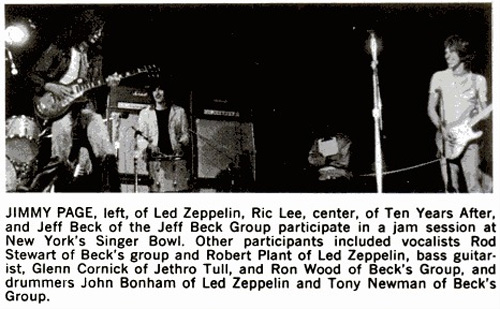
Probably the most
difficult assignment of the evening belonged to Pavilion’s Edwin
Hawkins Singers, who had to open. The inclement weather, which
held the crowd to 7,000 made the audience, waiting for their
rock favourites, restless. Some rain during the set aided
neither audience nor performers. But, the large gospel choir was
at their fervent spirited best, giving an exceptional
performance, especially in their big hit “Oh Happy Day”.
The Beck Group had given
one of their best sets, especially by vocalist Rod Stewart and
Beck, another of today’s great guitarist. No sooner had Beck
explained that there would be no more encores, than the fun
began. Stewart was joined by Robert Plant of Led Zeppelin, one
of the most exciting vocalists on the scene. Glenn Cornick, bass
guitarist of Reprise’s Jethro Tull, joined in succeeding Ron
Wood of the Beck Group, as did drummer John Bonham another Led
Zeppelin’s group of star performers, who succeeded the groups
Tony Newman.
The excitement
heightened as Jimmy Page, another of the evening’s string of
great guitarist, joined the jam. Newman and Ric Lee joined in,
making three drummers performing simultaneously. Musicians not
only played and sang, they also danced, affected by the jam’s
high spirits. In fact, Bonham practically had to be dragged off
stage to end the jam.
Then came the Fudge with
their languid, deliberate style, strong vocals and the sinewy
organ playing of Mark Stein, who also possesses a good,
distinctive voice. It took a few numbers for group and audience
to warm to each other, but by the time the Fudge reached their
“You Keep Me Hanging On”
hit, all was in order and Stein was at his best. In the
following, “Take Me For A Little
While”, other musicians had their opportunities and they came
through splendidly, especially bass guitarist Tim Bogart, one of
the best in the business, whose solo again demonstrated the
variety that can be produced by that instrument. Lead guitarist
Vince Martell also came through well in his solo, the longest of
the evening. And, drummer Carmine Appice was strong as usual.
The show lasted well past midnight.
By Fred Kirby
The Singer Bowl Music
Festival took place on July 13, 1969 and will undisputedly go
down in the music history books as the heaviest show in the
stadium’s history. It included the following bands: The Edwin
Hawkins Singers (Oh Happy Day) Raven, Jethro Tull, The Vanilla Fudge, Ten
Years After, The Jeff Beck Group and a brand new band from
England called Led Zeppelin. As with all late 1960’s rock
concerts, there was the obligatory jam session at the end of the
show that included the members of Ten Years After,
Led Zeppelin and The Jeff Beck Group.
Notes:
Bonham was invited
backstage to a Ten Years After concert, he throws orange
juice on Alvin Lee the most respected guitarist of his
generation.
Notes:
Jimmy Page was
awe-struck by Alvin’s super-sonic playing, much to the
annoyance of an inebriated John Bonham who suddenly lurched
forward and threw a glass of orange juice all over Alvin’s
guitar, in order to slow up his (Alvin’s) finger work as the
strings and fret board got stickier. When asked about this
incident Alvin has no recollection of anything being thrown,
although Ric Lee confirms the story. Ric also remembers,
that at the end of the show, when he and Bonzo joined Jeff
Beck for the encore: “There was Robert Plant, Rod Stewart,
Jimmy Page, Jeff Beck and three bassists. I think Bonzo was
beating off a riff (The Stripper) on the drum kit, so I
grabbed a floor tom and started thumping hell out of it. The
crowd were going ape-shit as we banged out a blues standard
and Bonham who was already stripped to the waist, took off
his trousers and under pants. He was sitting there naked,
playing away, when the police saw him, I then saw Peter
Grant and Richard Cole spotting the police as the number
fizzled out, all I saw was Peter and Richard running on
stage, each grabbing one of Bonzo’s arms and his bare-arse
disappearing as they carried him off”.
Ric Lee (Drummer Ten
Years After)
This article starts
off with The Jeff Beck Group performing at Schenectady Hall
in upstate New York. Led Zeppelin having just been signed to
the same stable as The Jeff Beck Group, and under the
management of Peter Grant. Both bands were to cross paths
over the next few days as Led Zeppelin were also in the
American East Coast at the time, on their inaugural United
States tour, and arrangements were quickly made for the two
bands to hook up for some serious partying. Imagine, The
Jeff Beck Group and Led Zeppelin – talk about an explosive
combination! The problem is, great talents are notoriously
“too hard to handle”.
Jeff Beck, one of
the worlds greatest guitarist and a proven record seller,
temperamental often stroppy but always ready to pull a
rabbit out of the hat. Led Zeppelin was coming along on the
Jeff Beck Group’s tour bus to the Schenectady Hall gig. But
it was at the Singer Bowl concert where the trouble was
already brewing. The Singer Bowl is a massive sports complex
doubling as a concert venue just outside of New York’s
Flushing Meadows, and things were coming to a head.
Jeff and the boys
were supporting America’s newest flavour of the month, The
Vanilla Fudge a band out of Long Island, New York. More
significantly, as it turned out, Alvin Lee’s new band called
Ten Years After, were opening the star-studded bill. The Led
Zeppelin boys and their entire entourage said they’d be
there to lend Jeff a bit of moral support. I thought, that
was quite touching to begin with, such a selfless solidarity
between two of the UK’s best bands while they were touring
on foreign turf. But of course it wasn’t as simple or as
innocent as that. Nothing ever was! As hindsight being 20:20
maybe I should have guessed that there was more to their
eagerness to attend this particular gig, than just helping
their mates along.
In fact, that had
nothing what-so-ever to do with it. The Led Zeppelin boys
were there to settle a score with Alvin Lee for some pretty
nasty remarks he’d once made about Jimmy Page and Jeff
Beck’s roadies seemed happy to help them wreak their
revenge, egged on inevitably by John “Bonzo” Bonham and
Richard Cole.
Chick Churchill, one
of Ten Years After’s associates (keyboard player) was
unlucky enough to be caught without back up in a locker room
by a vengeful rabble of roadies who scared the crap out of
him before ruthlessly stripping him of his clothes. Then
they stripped him of his dignity by dumping him naked and
tossed like a lamb to the slaughter in the starkly lit
corridor outside. Next it was Ten Years After’s turn for the
revenge of Led Zeppelin.
Hidden in the
anonymity of the shadows, in a corner right in front of the
stage, the Led Zeppelin crew pelted Alvin Lee mercilessly
from the moment he took the stage, with anything that came
to hand, including hot dogs, burgers, orange juice and
probably much messier and more painful missiles. It was
glorious! Alvin Lee and his band had no idea who the
mysterious assailants in the shadows could be. The shower of
debris stole their thunder, undermining the storming
performance that they’d had their hearts set on, and
understandably enough, mediocrity was all they could muster.
In retrospect, Peter Grant and Jimmy Page, the two partners
in crime had to be behind this. It was their way of saying,
“don’t ever mess with the Zeppelin!” If that had been the
sum total of their retribution for Alvin Lee’s off colour
comment, I guess it would have been “fair dos”. But they’d
already planned a masterstroke that would add insult to
injury. Of course, as far as the audience was concerned, Led
Zeppelin joining the Jeff Beck Group on stage as an
impromptu jamming session. I knew different! Having ruined
Alvin Lee’s entire set, a band that hadn’t even been booked
to play, was about to steal the show…. and steal the show
they did. But even the Led Zeppelin boys hadn’t planned the
finale that was to be the highlight of the night!
The Real Story of
“Bonzo” at the Singer Bowl:
Bonzo had been at
the backstage booze, nothing strange or unusual about that,
or about the fact that, drunk as a lord, his drumming on the
fast blues the galaxy of rock stars was playing was as
blisteringly bang on the nail as ever. What was a bit
unusual was the fact that he’d suddenly decided to do a
“full – monty” while he was at it, still hitting that kick
drum with mechanical, maniacal precision and venom despite
the strides and underpants that were now tangled around his
ankles. For most of the audience, the sight of his private
pubic hair being made public, was just a bit of a “Bonzo –
Bonus” to the already exciting event. But among the ogling
crowd, some punters were less than impressed at the sight of
Bonzo’s manhood flapping about on the drum stool. I clocked
one humourless woman talking animatedly to one of the fairly
heavy local police presence like a chill wind, the prudish
outrage swept through the crowd and it was clear to see that
the cops were not amused. Now, I’m not saying I’d normally
think Bonzo getting his kit off was going too far. On the
contrary, high spirits and outrageous behaviour like that
are all part of the sheer joy of rock `n´ roll, and long may
it stay that way. A few people will always be upset by it,
but when the police are among the ones with the hump, that’s
when the fun stops and the trouble begins. Of course it was
my job to make sure it didn’t. I could see the cops rallying
together, conferring and calling for back-up. I had to get
Bonzo off the stage before they could arrest him.
Suddenly,
I had a plan. I took Henry the
Horse aside and told him to kill all the lights the moment
the performers finished their song. He did so, plunging the
stage into total darkness for about ten seconds, just long
enough for Richard Cole and I to grab Bonzo under the arms,
pull his pants up and drag him full pelt backstage.
Obviously, we couldn’t try and hide him here, right in the
bands dressing area, that is the first place the cops would
look for him. So we lugged him into another locker room that
was equipped with shower facilities and the like and the
walls plastered with sporting paraphernalia, I assumed it
was an American Football players changing room. Somewhere
out there, the police were stumbling about in the darkness
and their mood was turning as black as the blackout that we
plunged them into. I kicked the door shut and locked it.
Hearts banging as loud as Bonzo’s drumming, and holding our
breath in case we were heard. Richard and I sat about
tidying up the legless stickman. We waited, and Bonzo by now
was unconscious and his body draped lifelessly over a chair,
marooned helplessly in the empty tiled expanse of the
backstage changing room. With the distant rumble of very
angry men echoing along the corridors outside, then suddenly
it loomed uncomfortably close and then there was an
explosion of outraged voices. At first it was an
incomprehensible babble, then it was way too close and
clear. “Where is the dirty motherfucker?” One loud American
voice kept roaring with an authority that cut through the
general furore. At least I thought, we were safely locked in
this room, and no one was able to hear us. Bonzo was
temporarily out of commission. Keep calm and we’d be in the
clear.
But then there was a
thunderous banging at the door, the kind of persistent
banging that won’t take no for an answer. The door burst
open to reveal five or six huge cops with waists as wide as
their minds were narrow. Some traitor must have given them
the master (Skelton) key.
Needless to say, we
were out numbered, out muscled, out weighed and most
importantly, out-lawed. Richard
and I stood in front of Bonzo in a forlorn attempt at
solidarity, as if we could hide and protect him. Two of the
police posse strode forward and too close for comfort,
intimidating, demanding to know if this was the drummer
who’s just given his public a pubic naked performance? The
cops language and attitude was far from delicate about it.
“Look, he’s just
drunk, he’s harmless” I spluttered. (showing no signs of a
clear and present danger to anyone). Look at him, he didn’t
mean any harm…..” The cops looked with utter distaste over
my shoulder at the inert figure sprawled over a chair in the
middle of this bleakly lit and Spartan room. Neither was
impressed. Their collective sense of humour bypass was
obviously complete. I suppose it wasn’t much of an excuse.
It can’t have been, because then they whipped out their
batons threateningly, making it utterly clear that they
meant business. To be honest, at that point, Richard and I
had given up the ghost. We were all going to get nicked and
that was that. But neither we nor the cops had reckoned on a
far more superior authority. I’d thought the police had made
a fairly impressive entrance just minutes ago, but the door
through which they’d marched with such self-righteous
import, suddenly exploded open once again to admit the
furious, fuming and fighting mad figure of Peter Grant.
He was always almost
ludicrously huge, but when fluffed up, furious and bristling
with rage like a giant mother hen, hell-bent on protecting
her chicks, he almost too the door right off its hinges. The
door wasn’t the only thing almost unhinged by this entrance:
the cops clucked in panic, overshadowed and over-awed and
chickening out completely. “I’m the manager of the band”,
Grant Boomed Imperiously. “Who’s in charge here?” The gob
smacked police officers silently pointed out their Captain,
whose eyes met Peter’s and were fixed in his glare. Peter
said, “you and me need to talk – alone” he said quietly.
“get your men out of here”. With a wave of his arm the
Captain dismissed his troops and Richard and I followed
suit, we didn’t need telling, closing the door carefully
behind us, we left Bonzo, Peter and the Captain in the room
and waited – waited – and waited. Finally, after about ten
minutes, that seemed so much longer, the Captain emerged,
all that anger drained from his face and beckoned his men to
follow. Bemused, we gingerly stepped back into the locker
room where Peter greeted us with a smile. “Well done!” he
beamed, “Now, lets get Bonzo on the bus”. I don’t need to be
told twice. I grabbed the still prone Bonzo and hauled him
bus-wards and within minutes Peter and the Led Zeppelin
boys, complete with their semi-conscious drummer, were
speeding out of town. No charges were pressed, no arrest
were made, in fact, it was as if the incident never happened
at all. Peter’s unique brand of diplomacy had somehow
convinced the outraged cop captain to let the entire matter
drop. It was amazing the authority that Peter Grant
commanded. Maybe it was his sheer size and physical presence
of his wallet, as I found out when I asked him later on the
tour bus. His reply was, “That was a cheap get-out Don!” He laughed heartily,
“it only cost me $300.00!”
Epilogue:
For a great many
years, this orange juice story has been circulating around
in bits and pieces, mostly concerned with who threw the
orange juice at Alvin Lee and his precious guitar.
What I did learn in
my little unprofessional investigation, was that all the
rumours held a basic seed of truth in them. It was a long
and complicated story, but in the end a fun mystery to
unravel. So the ultimate answer as to who threw the orange
juice is: Jeff Beck, John “Bonzo” Bonham and the Led
Zeppelin Roadies as pay back for off colour comments made by
one Alvin Lee towards Jimmy Page! The unfortunate
innocent bystander in all of this was Chick Churchill.
From Epilogue to
Introduction:
While this has
nothing to do with Alvin Lee or Ten Years After, the time
frame is so ironic and thus included here as well. Just
fifteen days after the Singer Bowl event, came the most
talked about incident in rock music history. The incident is
destined to take its place in your mythology, says Frank
Zappa, and he even wrote a song about it, appropriately
called: “Mud Shark” in June
1971 at the Fillmore East. I’ll make the event as short as
possible, and clean it up as best I can, it’s actually
pretty funny, and now engraved in stone in rock `n ´ roll
legend !
The Led Zeppelin
boys and The Vanilla Fudge guys and Leppelin’s road manager
Richard Cole, were heading to Seattle Washington to play the
Seattle Pop Festival on July 27, 1969 at the Gold Creek
Park.
The bands were staying at The Edgewater Inn which is
located right on the Puget Sound. What makes this place so
unique, is that you can go fishing right out of your hotel
window and in the comfort of your room.
The shark episode is
alleged to have involved some type of sexual contact with a
fish, (yes you heard right
a fish) with many variations of the story, all involving
some of the band members, as well as the type of fish
involved – often claimed to be a mud-shark. It was Jimmy
Page who caught a spiny "dog-fish" also called a "mud
shark". The groupie involved was Carmine Appice's groupie.
Rock writer Stephen
Davis in his Led Zeppelin book, “Hammer of the Gods”
reports: “One girl, a young
pretty girl with red hair, was disrobed and tied to the bed.
According to the legend, Led Zeppelin then proceeded to
place pieces of the mud-shark on her private parts”. The
band stayed in room 342 and the incident became known as
"the sleaziest moment in rock history". Zeppelin road
manager Richard Cole disputes this version and tells it this
way: “It wasn’t Bonzo, it
was me. It wasn’t a shark at all, and it was only the nose
of the fish that was put in. We caught a lot of big sharks,
at least two dozen, we stuck coat hangers through the gills
and left them in the closet…. It wasn’t a shark it was a red
snapper and the girl happened to be a red-head, and that’s
the truth. Bonzo was in the room, but I did it and Mark
Stein of Vanilla Fudge filmed the entire thing, and the girl
loved it. There was nothing malicious or harmful, no way! No
one was ever hurt – end of story.
A later visit by Led
Zeppelin in 1973, the band and their entourage caught some
thirty mud-sharks and left them under beds, in elevators, in
bath tubs, in hallways, in closets and all over their
rooms….while beds, TV sets, china, glassware, mattresses,
lamps, and drapes all ended up in Elliott Bay. The damage
they made, cost the band $2,500 and they were banned from
the hotel forever.
The Edgewater Inn
1964:
When first
constructed, it was called “The Camelot” then it was changed
to “The Edgewater Inn” and finally to just “The Edgewater”.
It’s a four story building with 223 rooms hotel, located in
Seattle, Washington, right on the central waterfront, on a
pier over Elliott Bay on Puget Sound. In the early years,
the hotel advertised on its north elevation that you could
fish right from your room. Some famous people have stayed
here over the years including:
The Rolling Stones,
The Beatles, Frank Zappa, Led Zeppelin, The Beastie Boys and
even U.S. President Bill Clinton. Over time Robert Plant was
welcomed back.
 The Beatles played
in Seattle, Washington, at the Seattle Coliseum. This was
during their very first American tour, and this was their
third show. This was on August 21, 1964. They played to
14,300 screaming fans, and this was at the height of
“Beatle-mania”. At the concert, the stage had to be raised
twelve feet for the bands protection. For their concert,
they were paid $34,569 dollars. The following day they left
for Vancouver, British Colombia. At the Edgewater Hotel the
band stayed in suite 272. The Beatles played
in Seattle, Washington, at the Seattle Coliseum. This was
during their very first American tour, and this was their
third show. This was on August 21, 1964. They played to
14,300 screaming fans, and this was at the height of
“Beatle-mania”. At the concert, the stage had to be raised
twelve feet for the bands protection. For their concert,
they were paid $34,569 dollars. The following day they left
for Vancouver, British Colombia. At the Edgewater Hotel the
band stayed in suite 272.
Even if there were
other factors at work in keeping the hotel open, many
acknowledge that,
“The Beatles” stay there helped cement the Edgewater’s place
in Seattle’s history Says the hotel manager Ric Nicholson:
“Now the Beatles and Rock and Roll History is what we hang
our hat on”. |
|
July 11 - 12, 1969 - Laurel Pop
Festival, Maryland
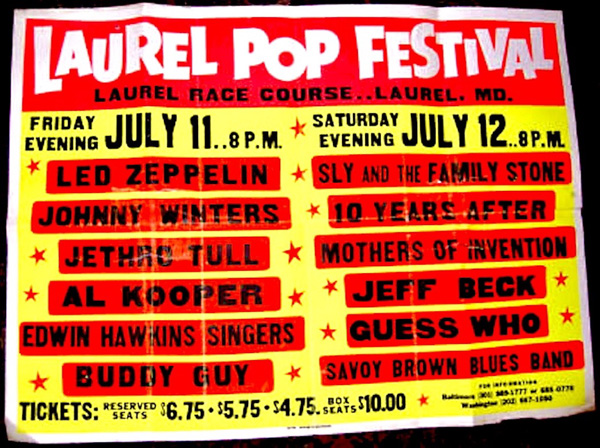
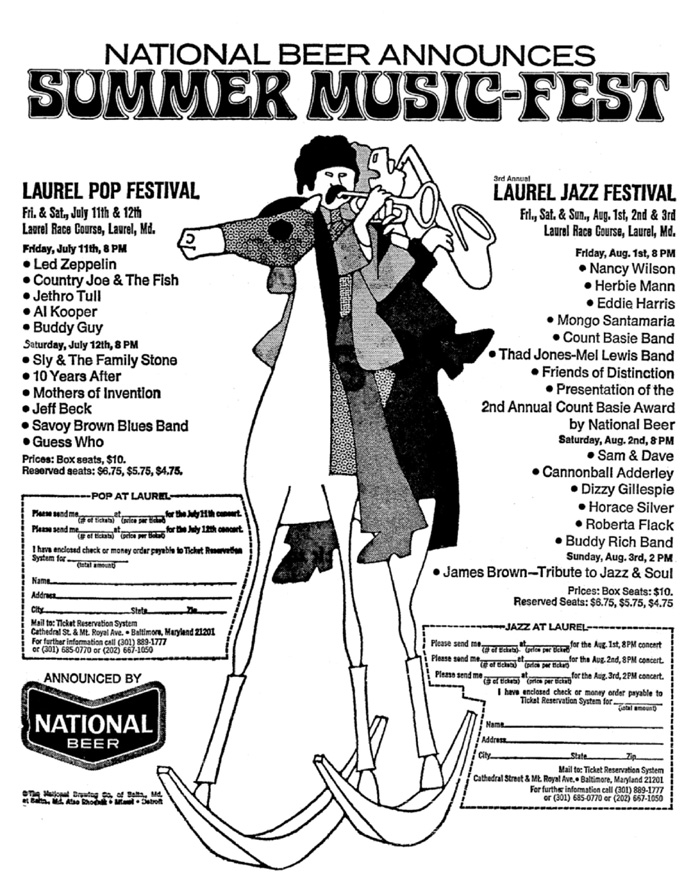
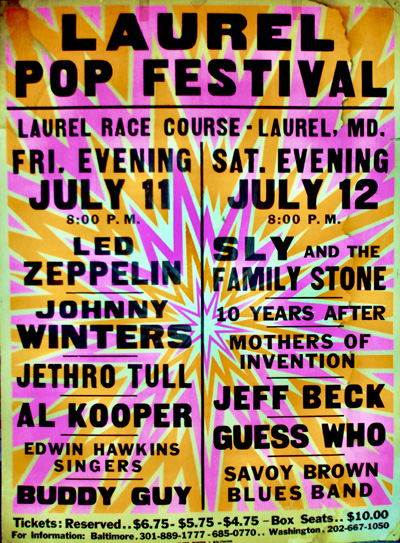
|
TEN
YEARS AFTER - Central Park, NYC
July 16, 1969
(Schaefer Music Festival,
Wollman Skating Rink)
Photography by Thomas Monaster
www.monasterphoto.com
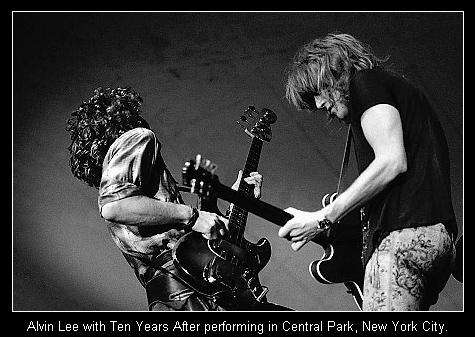
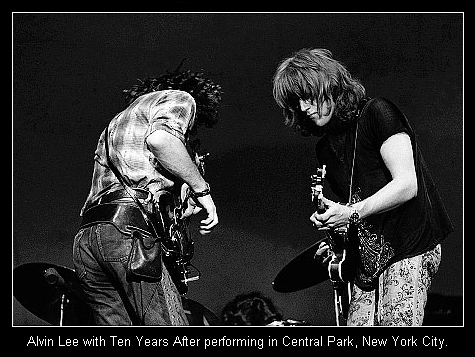
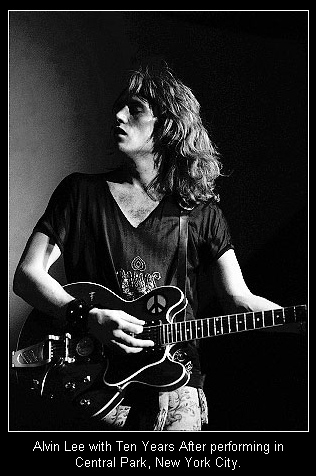
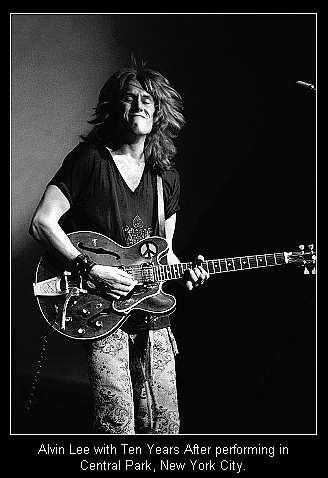
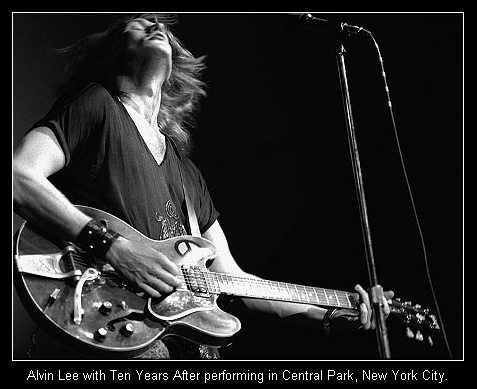
|
Ten
Years After – July 16, 1969
The
Schaefer Music Festival – Central Park, New York City
On the
bill are: Ten Years After – Chicago Transit Authority – and
Fleetwood Mac
(Fleetwood Mac was originally scheduled to play this date – but
were apparently cancelled)
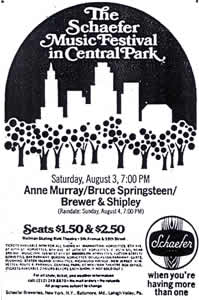
The Schaefer Music
Festival began its life as the Rheingold (Beer) Central Park
Music Festival in 1966. It was held during the summer
between 1968 and 1976 at the Wollman
Skating Rink which is now known as Trump Wollman Skating
Rink and located in New York City’s Central Park. This music
series was sponsored by the F. & M. Schaefer Brewing
Company, brewer of Schaefer Beer. This continued until 1976
at which point the sponsor became the owners of Dr. Pepper,
and then became known as, The Dr. Pepper Central Park Music
Festival.
Then, because of
residential complaints due to noise violations, the concert
series was then moved to Pier 84 on the west side of town in
1981 and 1982. Where by, it then changed hands once again.
In 1983 The Miller Brewing Company, the owners of Miller
Beer, took over sponsorship and it became Miller Time
Concert On The Pier, through 1988. The last thing I read
was, renowned club owner and musician Hilly Kristal who
founded CBGB’s in 1973,
co-founded the festival with producer and concert promoter
Ron Delsener took it over.
|
|

Fillmore West, San Francisco, July 22 - 24,
1969 - Artist: David Singer
|
The Seattle Pop Festival – July 25 –28 – 1969
– Prelude To Woodstock
It was held Gold Creek
about twenty miles outside of Seattle, and organized by Boyd
Grafmyre Promotions. The tension there was high, there was only
one thin chicken wire fence separating the stage – and us – from
50,000 rock fans. Twenty six musicians / groups performed there,
including: Ten Years After, Chuck Berry, Chicago Transit
Authority, Black Snake, Do Diddley, Albert Collins, The Doors,
The Byrds, Crome Syrcus, Tim Buckley, Floating Bridge, The
Flock, The Guess Who, The Flying Burrito Brothers, It’s A
Beautiful Day, Led Zeppelin, Charles Lloyd, Lonnie Mack, Lee
Michaels, Rockin´ FU, Murray Roman, Santana, Spirit, The Ike
and Tina Turner Review, Vanilla Fudge, Alice Cooper, Frosty and
The Youngbloods.
The recorded total
attendance for the three day event was 50, 000 rock fans
attended, many more than was expected, so extra food and water
had to be brought in. Reports say, that the people were orderly,
with a few minor exceptions. It was a non-stop music festival
and the first annual Seattle Pop Festival, that was a marvel of
crowd control and smooth organization. It was also the first
time ever that Led Zeppelin appeared on the same concert bill
with The Doors. The Zeppelin boys blew the doors right off the
stage, as they immediately followed the Doors set
The big mistake of all,
was hiring the Black Panthers to provide the Security. They cut
a hole in the fence and let anyone in who had money to pay them.
Besides that, half of the tickets presented at the main gate
were counterfeit.
This festival was held,
just a few weeks before the big Woodstock event took place, and
the bands who performed at Seattle also performed at Woodstock.
Seattle was to rival Woodstock in many people’s minds, but it
was not Woodstock, of that, there’s only one. As for Seattle,
just ask The Guess Who about this monster of a music festival.
It was Seattle’s version of Woodstock, and it’s now forty two
years later, but still some things never change:
“Near by neighbours
complained of traffic and the hippie atmosphere”. But the
message remains the same: “I disagree with their movement one
hundred percent”, said Dawsey,
“But some of us adults
better get the hell closer to them. They respond very much to
kindness, we older people better learn this – if they need a
drink of water, we the establishment, should go out and offer
it”.
Another fan says, “I
was so excited about going to The Seattle Festival, that I had
already made my plans to go to Woodstock. The reality was that I
probably enjoyed the Seattle Pop Festival more than I did the
Woodstock Festival. Seeing Albert Collins and Lonnie Mack was
kind of an education in a hardcore electric blues idiom, and Bo
Diddley and Chuck Berry were nothing if not great, and I mean
great showmen.
Ten Years After started
playing at 9:00 AM in the morning, fans said, it was a nice way
to wake up though. Ten years After and Santana were both
amazing, and they proved the same a few weeks later at
Woodstock. Also of note, The Ike and Tina Turner Review, was
hands down the best set, they kicked everybody’s ass – even
better than Led Zeppelin and
The Doors said one fan.
|
1969, July 25, Seattle Pop
Festival

Photo of Alvin Lee: Vladimir
Keremidschieff

Photo of Leo Lyons: Vladimir
Keremidschieff
|
1969, July 25 -
Seattle Pop Festival
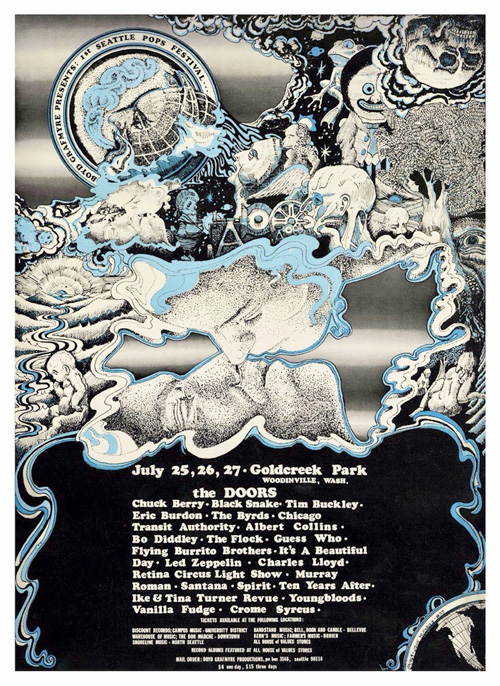
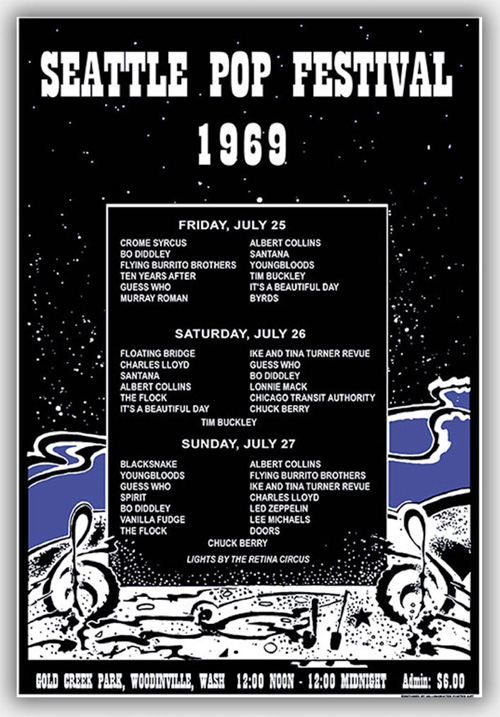
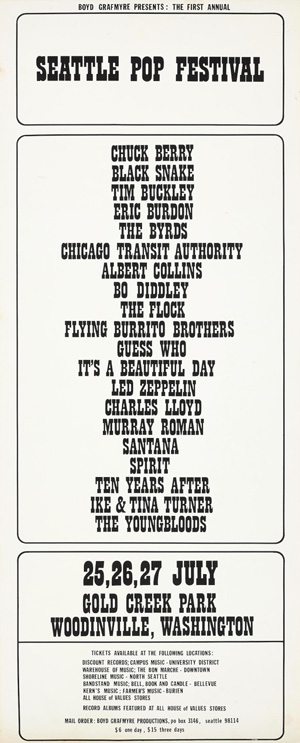
July 27, 1969 - Balboa
Stadium San Diego, California

Photos by Vladimir
Keremidschieff
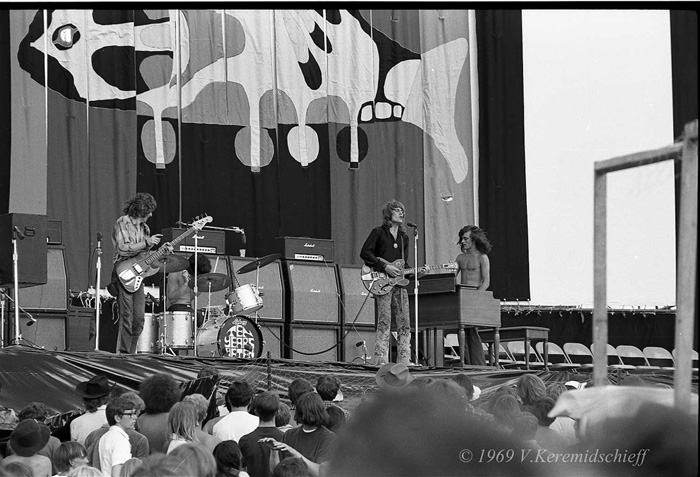
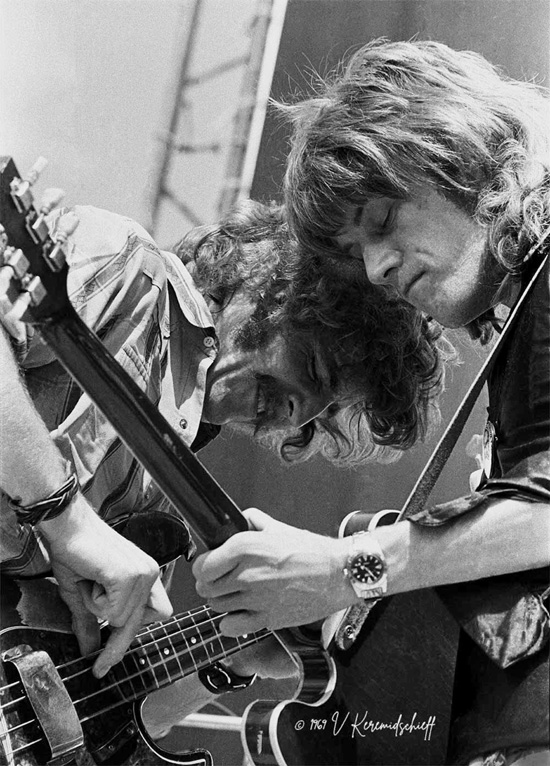
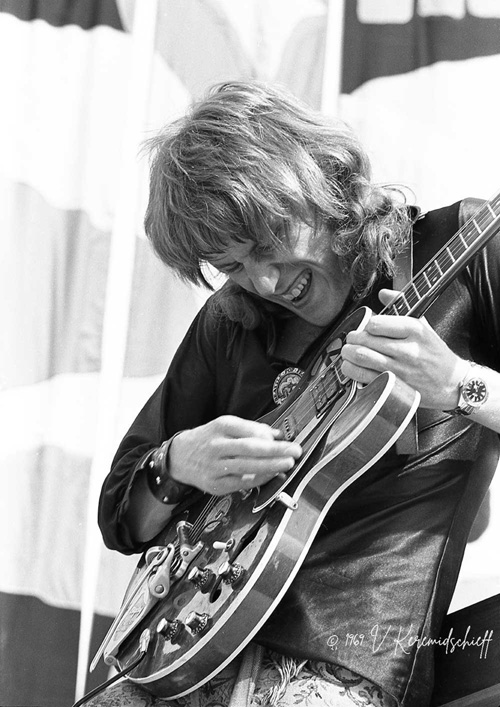
Many Thanks to Christoph
Müller for his contributions
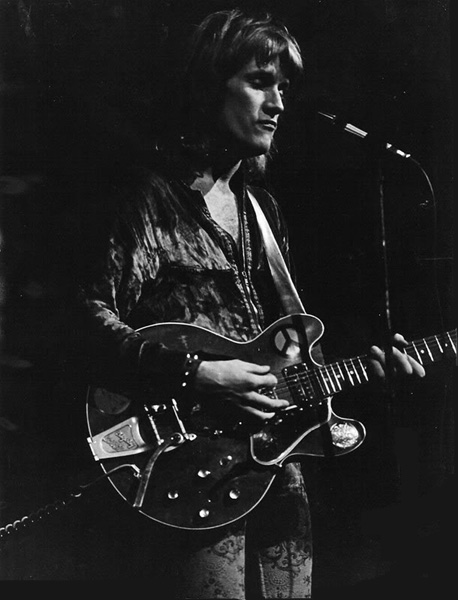
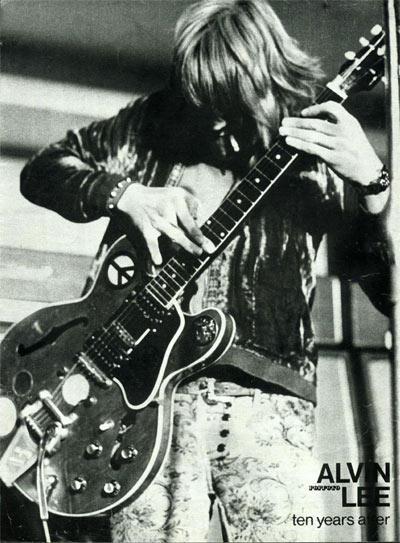
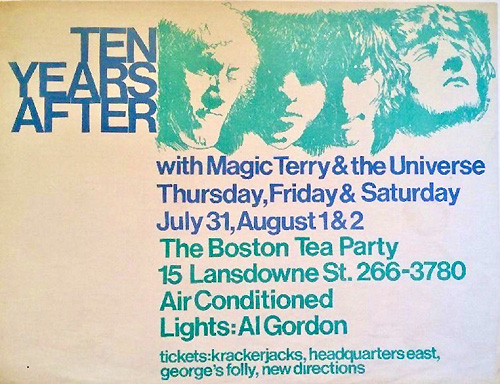
|
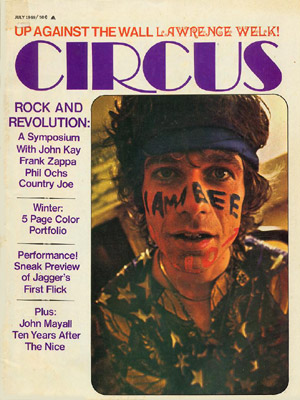
CIRCUS MAGAZINE – FROM JULY 1969
News
Stand Price - .50 – Fifty Cents
Photos
By Alan Grossman
TEN
YEARS AFTER:
Last
fall a relatively unknown English Blues group came to New York
to start the first leg of a national tour, that all but
changed the status of pop music in America. They played the
Fillmore East, The Scene, and did a memorable freebee in
Central Park with Traffic and Country Joe, establishing
themselves as a household word among rock fans in New York.
Ten
Years After is one of the best groups to come out of the
contemporary progressive blues movement. Their musicianship
both as a unit and in solos, far exceeds that of almost any
other group you can name.
Formed
in May 1967 in London, they worked at getting themselves
together for several months before making their debut
appearance at the Marquee Club there. From that point on,
Ten
Years After had little hassle getting people to listen to
them. It’s their desire to turn people on with their music,
that is, they dig audiences and get turned on themselves when
they see people appreciating music. To see them perform on
stage, one can easily sense the great amount of communication
that goes on between group and audience. Their live
performance leaves very little to be desired. They are
exciting, extremely versatile, very visual and seldom, if ever,
dull. Their repertoire ranges from heavy blues to pure rock
and roll and enables the listener to gain a better
understanding of the blues idiom in rock and other current
musical trends.
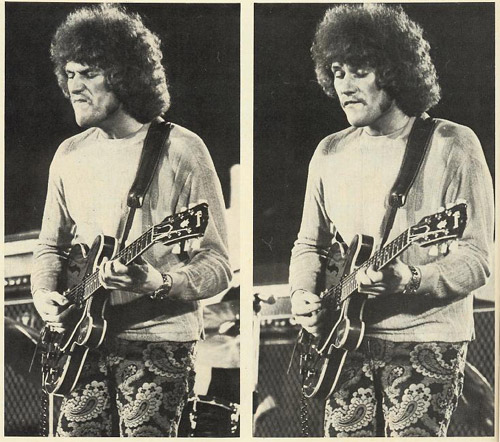
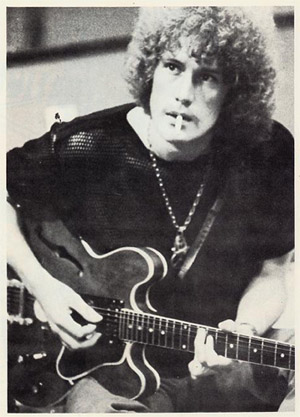
Alvin
Lee, lead guitarist and vocalist has to be one of the best
guitarist in the field. He has been praised by his peers and
audiences alike. He is and excellent blues singer and his
facial expressions alone are worth the price of admission.
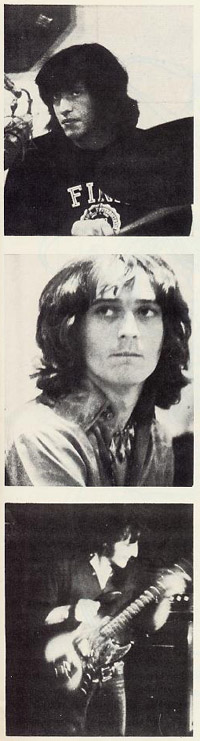 Their
live version of The “Stones” “Goin´ Home” is a hard
driving rock spectacular which makes you remember what rock
and roll really is. During the break in this number they go
into several rock riffs including bits and pieces of “Route
66” and “Blue Suede Shoes.” It really knocks you out.
Alvin Lee plays his guitar with the microphone stand (don’t
ask me to explain) and switches to playing it with a drumstick.
The amazing part is that he never misses a note, and he’s
playing damn fast! Their
live version of The “Stones” “Goin´ Home” is a hard
driving rock spectacular which makes you remember what rock
and roll really is. During the break in this number they go
into several rock riffs including bits and pieces of “Route
66” and “Blue Suede Shoes.” It really knocks you out.
Alvin Lee plays his guitar with the microphone stand (don’t
ask me to explain) and switches to playing it with a drumstick.
The amazing part is that he never misses a note, and he’s
playing damn fast!
Leo
Lyons, the bass player, is a dynamic musician who credits Bill
Black, Elvis Presley’s early bass player, as one of his
influences. Chick Churchill is an accomplished classical
pianist who worked as the groups´ road manager before
actually joining as their organist.
Ric
Lee (no relation to Alvin) is the drummer who credits Buddy
Rich and Joe Morello among his influences. He does a long solo
in their live sets, which ranges from mediocre to excellent,
depending on how well he feels when he’s doing it. However,
he is a rather creative and solid drummer who complements the
rest of the group well. They are without a doubt a “must see.”
Ten
Years After has three LP’s on the Deram label; Ten Years
After, Undead, and Stonedhenge, their latest work, which takes
the music of Ten Years After a few steps further,
incorporating more jazz and progressive rock than before. They
are currently on their second tour of America, which includes
a gig at the Newport Jazz Festival. (That in itself tells you
plenty.)
You
may ask one more question. What does Ten Years After mean?
According
to Chick Churchill, “It could mean ten years after the
present day which would be 1979, or ten years after 1959 which
would be today.” You figure it out for yourself ....
Special
Features by, John Leitzes
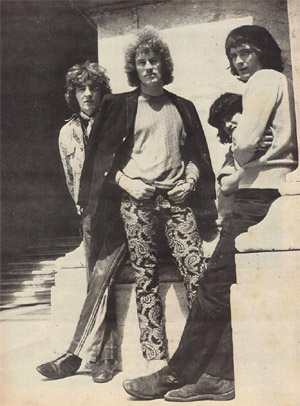
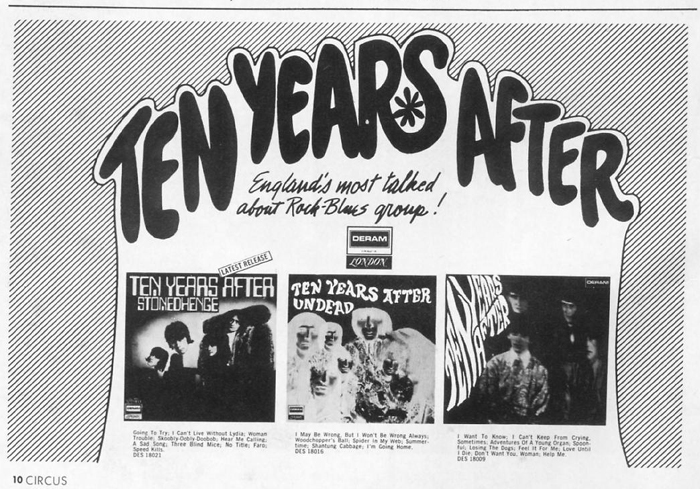
|
|